How to Keep Your House Cool Without Running the AC Using Smart Tech.Last summer, my regional electric utility sent out one of those dreaded “peak energy event” push notifications. Outdoor temperatures in our neck of the woods (US Climate Zone 4) pushed past 98°F with 75% relative humidity. Electricity rates on my variable-rate plan spiked to an eye-watering 38 cents per kilowatt-hour. Turning on our central HVAC would have meant adding roughly $25 a day just to keep the ground floor tolerable.
- 1. 1. Thermal Auditing: Mapping Heat Ingress with Smart Tech
- 2. 2. Solar Defense: Low-E Window Film and Motorized Smart Blinds
- 3. Low-E Window Film Testing
- 4. Automating the Perimeter with Motorized Smart Blinds
- 5. 3. Airflow Physics: Mastering Cross-Ventilation and the Stack Effect
- 6. Cooling House with Box Fans Windows (The Right Way)
- 7. The Power of a Whole-House Attic Fan
- 8. 4. Nocturnal Purging and Managing Thermal Mass
- 9. 5. Slashing Internal Heat Loads and Vampire Power Draw
- 10. Eradicating Vampire Power Draw
- 11. The Kitchen Shift
- 12. 6. The Two-Summer Data Breakdown: What Actually Worked
- 13. Frequently Asked Questions
- 14. Does leaving ceiling fans on actually cool down an empty room?
- 15. What is the ideal direction to run ceiling fans during summer?
- 16. Can I leave my windows open all day if there is a breeze?
- 17. Does closing interior doors help keep the house cooler?
- 18. Is window tinting safe for double-pane Low-E windows?
I decided to run an experiment. Could I maintain a comfortable indoor environment—below 76°F during the hottest hours of the day—without ever flipping the breaker for the central compressor?
It turns out you don’t need to roast in your own living room to dodge a punishing utility bill. Keeping a house comfortable during scorching weather comes down to three things: stopping solar radiation before it penetrates your envelope, weaponizing air pressure differentials, and using cheap smart home gear to automate the physics. Here is the blueprint I built and refined over two full summers of testing.


1. Thermal Auditing: Mapping Heat Ingress with Smart Tech
Most people trying to figure out how to cool house without ac start by buying expensive tower fans. That is a mistake. Fans move air over your skin to create a convective cooling effect, but they do nothing to reduce the thermal load of the structure itself.
Before touching a fan, you need to understand where heat is breaching your perimeter. Heat transfers through conduction, convection, and radiation. In standard American wood-frame homes, solar radiation hitting standard double-pane glass accounts for up to 76% of the sunlight that falls on standard double-pane patio doors and windows entering the home as heat, according to the U.S. Department of Energy (DOE).
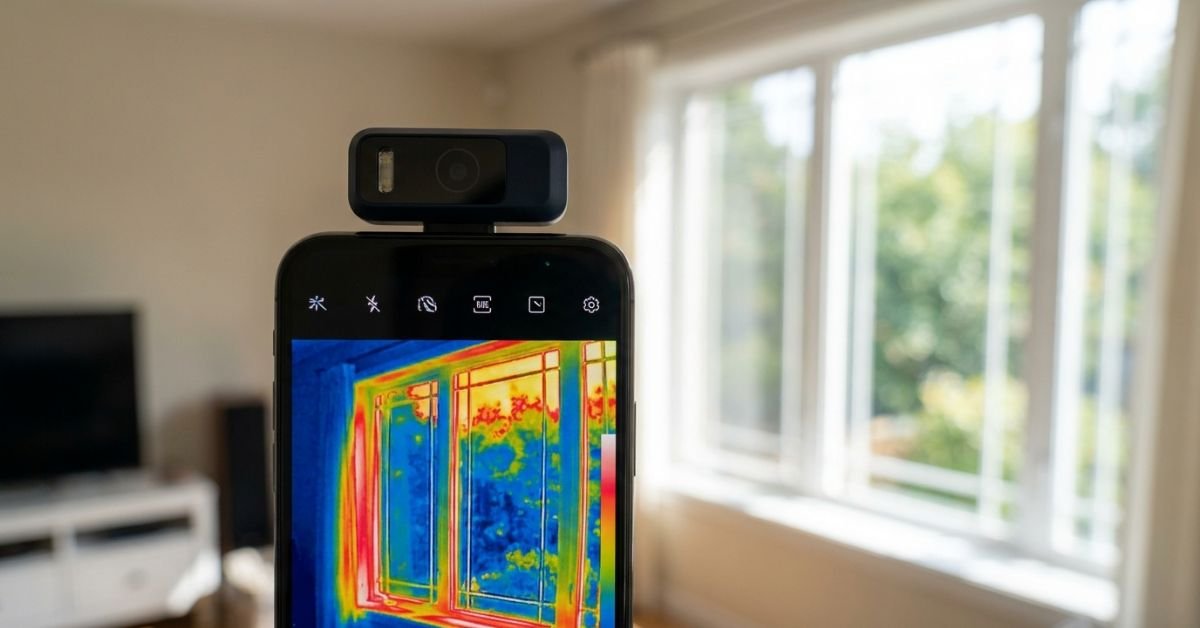
To baseline my house, I deployed six Sonoff Zigbee temperature and humidity multi-sensors connected to my Home Assistant server. I placed one on the north exterior wall, one in the attic crawlspace, and the rest across south- and west-facing rooms. Then, I borrowed a FLIR ONE thermal imaging camera that plugs straight into a smartphone.


Midday audits revealed wild surprises:
💰 More Cheap Living Tips You'll Love
- First Steps to Take When You Decide to Get Out of Debt
- Save Money or Pay Off Debt First? Tech-Driven Guide
- Debt Snowball Method: How It Works (With Real Example)
- How Long to Pay Off Debt? Tech Tools to Find Out Fast
- Lower Your Electric Bill as a Renter: 12 Cheap Tech Ways
- Debt Avalanche Method Step by Step: Fast Debt Payoff
- Our south-facing dining room wall was acting as a massive radiator, reading 89°F on the interior drywall because the contractor had skipped batts of fiberglass insulation around an electrical chase.
- The uninsulated pull-down attic stairs were leaking 115°F air directly into the upstairs hallway via unsealed perimeter gaps.
- The decorative, dark-bronze metal frames on our west-facing windows were conducting blistering 122°F heat right through the thermal breaks.
By finding these thermal bridges, you stop guessing. A $15 roll of closed-cell foam weatherstripping and an insulated attic tent cover dropped that hallway reading by 7°F within forty-eight hours.


2. Solar Defense: Low-E Window Film and Motorized Smart Blinds
Stopping heat before it penetrates the glass is ten times more effective than trying to manage it once it is already indoors. If you want to know how to keep house cool in summer naturally, start at the window glazing.
Low-E Window Film Testing
I tested three distinct films across our west-facing facade to find the best window film for heat reduction. Standard solar tint films darken the room significantly, which makes the house feel like a cave. Ceramic spectrally selective Low-E window film is radically different. It rejects infrared heat while allowing maximum visible light transmission (VLT).
Film Type                Visible Light (VLT)   Solar Heat Rejection (SHGC)   Internal Temp Drop
Standard Dark Tint       20%                   52%                           -4.1°F
Reflective Mirror Film   15%                   73%                           -8.6°F
Nano-Ceramic Film        65%                   68%                           -7.8°F
The ceramic film hit the sweet spot: it maintained daylighting so we didn’t have to turn on indoor lights (which create secondary heat), yet slashed the surface temperature of the interior glass by almost 15°F during peak afternoon solar radiation.
Automating the Perimeter with Motorized Smart Blinds
I paired the film with motorized smart blinds (I used retrofitted Zigbee roller motors from Aqara). The automation logic isn’t tied to a clock; it’s tied to solar azimuth and outdoor lux sensors.
When the sun hits an angle where direct rays strike the glass, the blinds drop automatically to trap the radiant energy in the small air pocket between the fabric and the pane. Once the sun dips behind the treeline on the west side, the blinds open right back up. Passive protection, zero manual effort.
Pro Tip: Never use dark interior curtains on unfilmed glass without a white, reflective backing. Dark fabrics absorb solar radiation and convert it directly into ambient heat inside the room, essentially creating an indoor space heater.
3. Airflow Physics: Mastering Cross-Ventilation and the Stack Effect
Once the sun goes down and ambient outdoor air temperatures drop below your indoor reading, your strategy flips completely. You move from thermal defense to active heat extraction.
This relies on passive cooling techniques for homes combined with targeted mechanical assistance. The secret lies in understanding the stack effect and fluid dynamics.
Cooling House with Box Fans Windows (The Right Way)
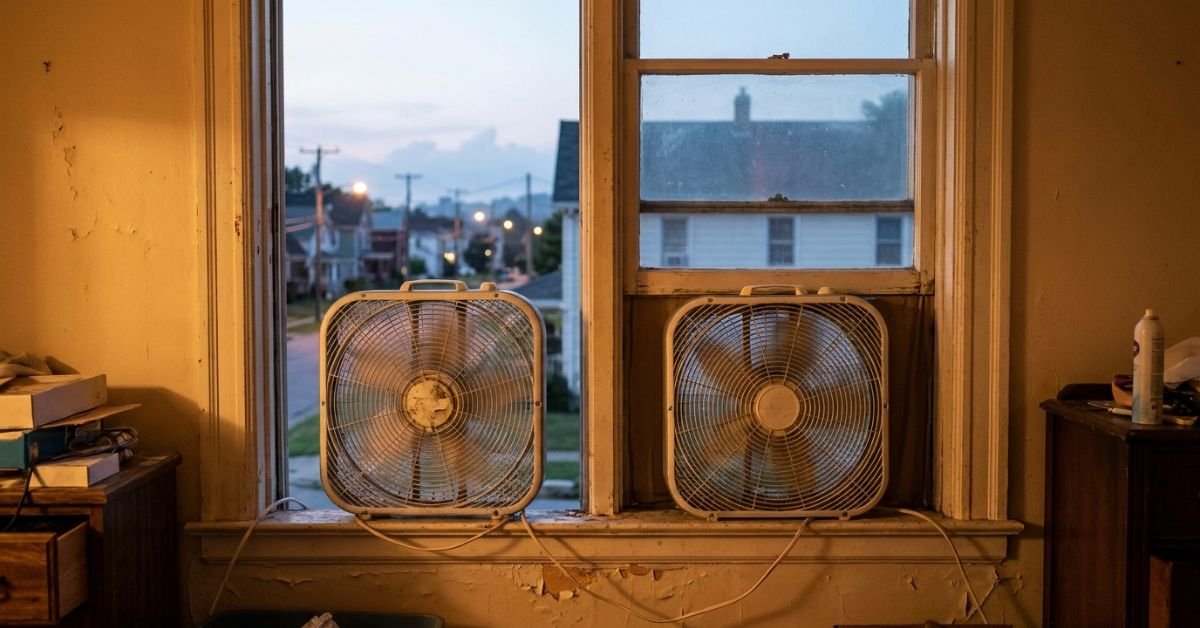
Most people throw a standard $20 box fan on a windowsill, turn it on high, and point it directly at their bed. While that provides direct evaporative cooling for your skin, it does a poor job of cooling the structure.
To flush thousands of cubic feet of hot air, you need to set up intentional cross-ventilation:
- Locate the Low-Pressure Side: Open windows on the side of the house opposite prevailing breezes or on the cooler, shaded ground floor (intake).
- Set the Exhaust High: Open windows on the top floor or the leeward side of the home (exhaust).
- The Bernoulli Spacing Trick: Do not wedge the exhaust fan directly against the window screen. Pull a high-velocity box fan back roughly 2 to 3 feet from the open window sash, blowing outward. This creates a pressure cone that pulls surrounding indoor air along with the direct stream (entrainment), moving significantly more cubic feet per minute (CFM) than a fan jammed into the frame.
       [Cool Night Air Inflow] ---> Ground Floor Window (Shaded)
                                         |
                                         v
       [Thermal Mass Heat Transfer] (Drywall, Furniture, Floors)
                                         |
                                         v
       [Rising Warm Air Stack Effect] ---> Upstairs Window ---> [Fan 2-3 ft Back Exhausting Out]
The Power of a Whole-House Attic Fan
If your home layout allows it, install a modern, variable-speed whole-house attic fan featuring insulated, motorized dampers. Unlike an attic ventilation fan (which only vents the crawlspace roof), a whole-house fan pulls massive volumes of air through your open first-floor windows, drags it through your living spaces, and blasts it out through the attic louvers.
I set our system to kick on only when two conditions are met: outdoor temperature is at least 3°F lower than inside, and indoor relative humidity remains below 60%. It replaces the entire volume of air inside the house every three minutes, pulling stored heat out of the subflooring and framing.
4. Nocturnal Purging and Managing Thermal Mass
Air warms up and cools down quickly, but the physical elements of your house—concrete foundations, drywall, countertops, and tile—have high thermal mass. During a heatwave, these materials absorb thermal energy all day long. Even if you cool down the air inside, the walls keep radiating heat right back at you well past midnight.
This is where nocturnal purging becomes essential.
By pulling continuous 62°F to 68°F night air through the structure from 10:00 PM until 6:30 AM, you “supercool” that internal thermal mass. When you close the house up tight in the morning before direct sunlight hits, those chilled floors and walls act as giant cold-sinks, absorbing ambient heat for several hours before indoor temperatures start to drift upward.
Hour-by-Hour Summer Thermal Management Routine:
----------------------------------------------------------------------------------
06:30 AM | Shut all windows and lower east/south motorized blinds.
10:00 AM | Check smart plugs to shut down idle electronics; verify low solar gains.
01:00 PM | Peak solar hours: Drop west blinds; run ceiling fans counter-clockwise (occupied rooms only).
06:30 PM | Outdoor temps peak and begin dropping; keep house sealed.
08:30 PM | Outdoor temp falls below indoor temp: Open intake/exhaust pathways.
09:00 PM | Spin up attic fan or window exhaust fans for nocturnal purging.
A quick word on evaporative cooling: If you live in an arid western state (like Arizona, Nevada, or eastern Oregon), evaporative cooling (or “swamp coolers”) is magic. Adding water vapor to dry air absorbs sensible heat via phase change, easily dropping intake air temperatures by 15°F to 20°F with negligible power use.
However, if you reside east of the Mississippi or along the Gulf Coast, running an evaporative cooler indoors during July is a disaster. High indoor humidity makes it impossible for your body to sweat efficiently, effectively making 78°F feel like 86°F. Know your climate zone before introducing moisture into your cooling equation.
5. Slashing Internal Heat Loads and Vampire Power Draw
It makes no sense to fight outdoor heat while generating small furnaces inside your own living room. When chasing real efficiency, eliminating waste heat is the lowest-hanging fruit.
Eradicating Vampire Power Draw
Every watt consumed by an appliance inside your home’s insulated shell eventually degrades into heat. That high-end gaming desktop running on standby? It pulls roughly 15 to 25 watts continuously. Your older secondary refrigerator in the garage or utility closet? Easily 100 to 150 watts of continuous motor heat.
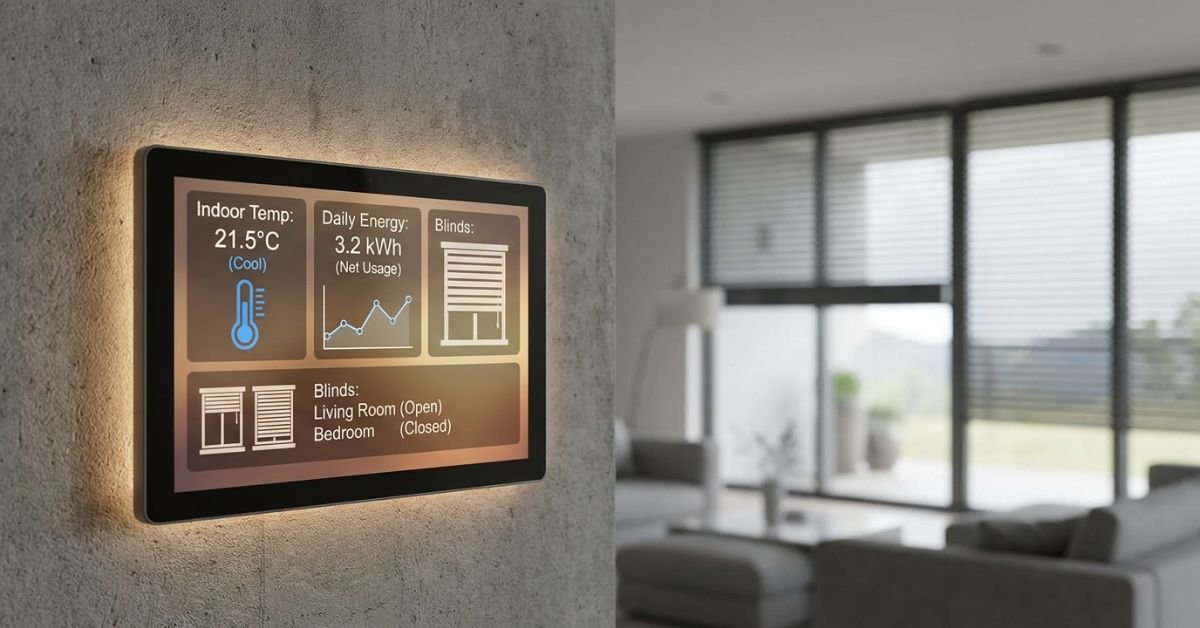
I wired high-draw zones with smart energy-monitoring plugs. Using Home Assistant, I created an automation that cuts power completely to our home theater system, standing gaming rigs, and secondary chargers whenever they drop into an idle state for more than 20 minutes. Cutting 180 watts of continuous vampire power draw across the house eliminated around 614 BTUs per hour of internal heat output.
The Kitchen Shift
Running an electric resistance oven for an hour adds roughly 8,000 to 11,000 BTUs of heat directly into your living spaces. That forces your cooling strategies into overdrive.
During our two-summer test:
- We swapped completely to an outdoor portable induction burner or high-efficiency air fryer. Induction transfers energy directly to the iron molecules in the cookware, creating almost zero wasted ambient radiant heat compared to gas burners or radiant coils.
- We set our smart dishwasher to delay its sanitize-and-dry cycle until 3:00 AM, right when the nocturnal purging exhaust fans were already pulling air through the home.
6. The Two-Summer Data Breakdown: What Actually Worked
After logging two years of sensor telemetry through heatwaves reaching up to 102°F, here is what the data proved:
Strategy Implemented                   Average Temp Impact      Cost to Implement
Ceramic Window Film (West/South)       -5.5°F to -8.0°F         $120 (DIY roll)
Nocturnal Purge via Window Pressure    -6.2°F (overnight base)  $45 (2 box fans)
Attic Hatch Insulation Seal            -2.4°F (hallway peak)    $25 (tent cover)
Automating Motorized Smart Blinds      -3.1°F (afternoon peak)  $110 (retrofit motors)
Vampire Draw Cutoffs                   -0.8°F (ambient average) $35 (smart plugs)
By systematically combining these techniques, our main floor never climbed past 75.8°F on a 99°F afternoon, despite leaving the central air conditioner’s breaker switched completely off. Our average monthly summer electric bill fell from $284 to $112, saving over $500 across the two hottest months of the year while drastically extending the lifespan of our HVAC hardware.
Frequently Asked Questions
Does leaving ceiling fans on actually cool down an empty room?
No. Ceiling fans cool people, not rooms. They create a wind-chill effect on your skin by speeding up sweat evaporation and convective heat dissipation. Leaving a ceiling fan spinning in an empty room does nothing to lower the ambient air temperature; in fact, the fan’s electric motor introduces a small amount of heat into the space. Turn them off whenever you leave the room to save power.
What is the ideal direction to run ceiling fans during summer?
Your ceiling fan should rotate counter-clockwise (when looking up from underneath the blades) on medium or high speed during the summer months. This direction forces the angled blades to push air straight down, creating a direct breeze. In the winter, you reverse the motor to spin clockwise on low, which pulls cool air upward and pushes settled warm air off the ceiling without creating an annoying draft.
Can I leave my windows open all day if there is a breeze?
Only if the outdoor temperature is lower than your indoor temperature. Once the outside air matches or exceeds your indoor reading, keeping windows open will quickly equalize the internal environment with the outside heat, regardless of how strong the breeze feels. Close and latch windows early in the morning before direct solar exposure begins, and don’t open them again until outdoor ambient temps drop below indoor levels in the evening.
Does closing interior doors help keep the house cooler?
It depends on your current ventilation phase. During the heat of the day, closing interior doors to unconditioned, unused spaces (like a laundry room, storage room, or guest bedroom with high solar heat gain) creates thermal buffer zones that prevent heat from migrating into your primary living spaces. However, at night during active flushing or nocturnal purging, open every interior door fully to maximize cross-ventilation and allow unrestricted airflow through the entire footprint of the house.
Is window tinting safe for double-pane Low-E windows?
You must verify the film type before applying it to modern double-pane glass. Applying high-absorption, dark-dyed films to the inside surface of double-pane windows can cause thermal shock stress, trapping excessive heat between the glass layers and potentially cracking the seal or pane. Always look for spectrally selective, dual-reflective, or ceramic films explicitly rated as safe for insulated glass units (IGUs).