How to Pay Off Debt Faster Without Earning More Money Using Tech.A few years ago, I stared at a spreadsheet tracking $18,400 across three credit cards and a lingering personal loan. The Federal Reserve’s reported average credit card APR was climbing well past 21%, and my statements were painful to look at. More than half of my monthly minimums were vaporizing into interest charges.
- 1. 1. Cash Flow Recalibration via Automated Banking Rules
- 2. Sub-Account Sandboxing and Direct Deposit Splits
- 3. Setting Up ACH “Balance Sweepers”
- 4. 2. Algorithmic Debt Prioritization: Avalanche vs. Snowball Software
- 5. The Best Debt Snowball Calculator App Setup
- 6. 3. Hands-On Micro-Payment Automation and Round-Up Tech
- 7. Bi-Weekly Payment Scheduling
- 8. Automated Micro-Savings Routed to Debt
- 9. 4. AI Bill Negotiation and Phantom Subscription Pruning
- 10. Slicing Out “Zombie SaaS”
- 11. Automated Bill Negotiation Bots
- 12. 5. Real-World Tech Scenarios and Common Pitfalls to Avoid
- 13. Case Study: Single Earner Household ($4,200/mo Net Income)
- 14. Pro Tip: Watch Out for Predatory Consolidation Traps
- 15. Frequently Asked Questions
- 16. What are the best apps that automate debt payoff without needing extra deposits?
- 17. Can I actually pay off credit card debt faster if my income is low?
- 18. Is the debt avalanche method really better than the debt snowball algorithm?
- 19. Do automated bill negotiation bots hurt my credit score?
- 20. What should I do if my bank doesn’t support direct deposit splits?
Everyone online had the same tired advice: Start a side hustle. Drive for Uber. Deliver burritos on weekends. Ask for a raise.
I didn’t have the bandwidth for a 60-hour work week, and frankly, my salary was locked in for the fiscal year. So I treated my personal balance sheet like an engineering problem. Instead of trying to earn more, I looked at how to pay off credit card debt without extra money by optimizing the cash flow I already had.
Over six months, I wired together banking rules, automated micropayments, and algorithmic payoff schedules. By treating every dollar like data packets routed across US banking rails, I shaved nearly three years off my payoff date and saved thousands in interest charges.


Here is the exact technical blueprint I used—tested across more than twenty fintech platforms—to wipe out high-interest balances using automated debt repayment strategies.

1. Cash Flow Recalibration via Automated Banking Rules
Most people fail to pay down debt because they rely on willpower at the end of the month. They wait to see what’s “left over” in their checking account, which is almost always zero.


If you want to master how to pay off debt fast on a low income or fixed salary, you have to invert the routing logic of your checking account. You don’t need more cash; you need to stop cash leaks before they happen.
💰 More Cheap Living Tips You'll Love
- How Long to Pay Off Debt? Tech Tools to Find Out Fast
- Debt Snowball on a Low Income: Does It Still Work in 2026-27?
- Debt Avalanche Method Step by Step: Fast Debt Payoff
- Save Money or Pay Off Debt First? Tech-Driven Guide
- Lower Your Electric Bill as a Renter: 12 Cheap Tech Ways
- Debt Snowball Worksheet: How to Fill It Out Correctly
Sub-Account Sandboxing and Direct Deposit Splits
Most major US retail banks (like Ally, Capital One, or credit unions running modern digital stacks) let you split your direct deposit across multiple internal accounts via your employer’s payroll portal (ADP, Gusto, Workday).


Instead of dumping 100% of your net pay into a primary checking account:
- Route 65% into an Obligations Account (rent/mortgage, utilities, baseline groceries, minimum debt payments).
- Route 20% directly into an Algorithmic Debt Payoff Hub (a designated account connected to your payoff scripts or tools).
- Route 15% into a Discretionary Spending Account paired with a debit card.
When your everyday card runs out of money, your discretionary spending stops. No mental math required.
Setting Up ACH “Balance Sweepers”
For banks without native sub-accounts, you can build your own rules using modern fintech layers. Using zero-based budgeting software like YNAB (You Need A Budget) or Monarch Money, every inbound dollar is immediately assigned a strict job before you can touch it.
I configure automated Automated Clearing House (ACH) pulls to sweep idle funds out of checking 48 hours after payday. By keeping checking balances artificially lean, you choke off phantom spending.
Money isn’t sitting there waiting to be burned on impulse purchases; it’s already en route to an outstanding principal balance.
2. Algorithmic Debt Prioritization: Avalanche vs. Snowball Software
When you’re trying to figure out how to pay off debt without a side hustle, your biggest enemy isn’t your principal balance—it’s compounding interest on a revolving credit facility. If you spread extra cash evenly across all your balances, you lose to the math.
You have two primary algorithms:
- Debt Avalanche Method: Mathematically optimal. Extra cash targets the balance carrying the highest APR (often 24% to 29.99%) while paying minimums on everything else. Once eliminated, the entire payment rolls into the next highest rate.
- Debt Snowball Algorithm: Psychologically optimal. Extra cash targets the smallest balance first, ignoring the APR, to generate rapid dopamine hits and reduce the total number of open tradelines.
+---------------------------------------------------------------+
|                DEBT REPAYMENT ENGINE COMPARISON               |
+-------------------+--------------------+----------------------+
| Feature           | Debt Avalanche     | Debt Snowball        |
+-------------------+--------------------+----------------------+
| Optimization Core | Total Interest Min | Behavioral Momentum  |
| Target Metric     | Highest APR First  | Lowest Balance First |
| Time to Free Cash | Slower at start    | Fastest immediate    |
| Total Money Saved | Highest possible   | Moderate             |
+-------------------+--------------------+----------------------+
The Best Debt Snowball Calculator App Setup
Rather than running static spreadsheets that break the moment an interest rate fluctuates, I rely on dynamic engines.
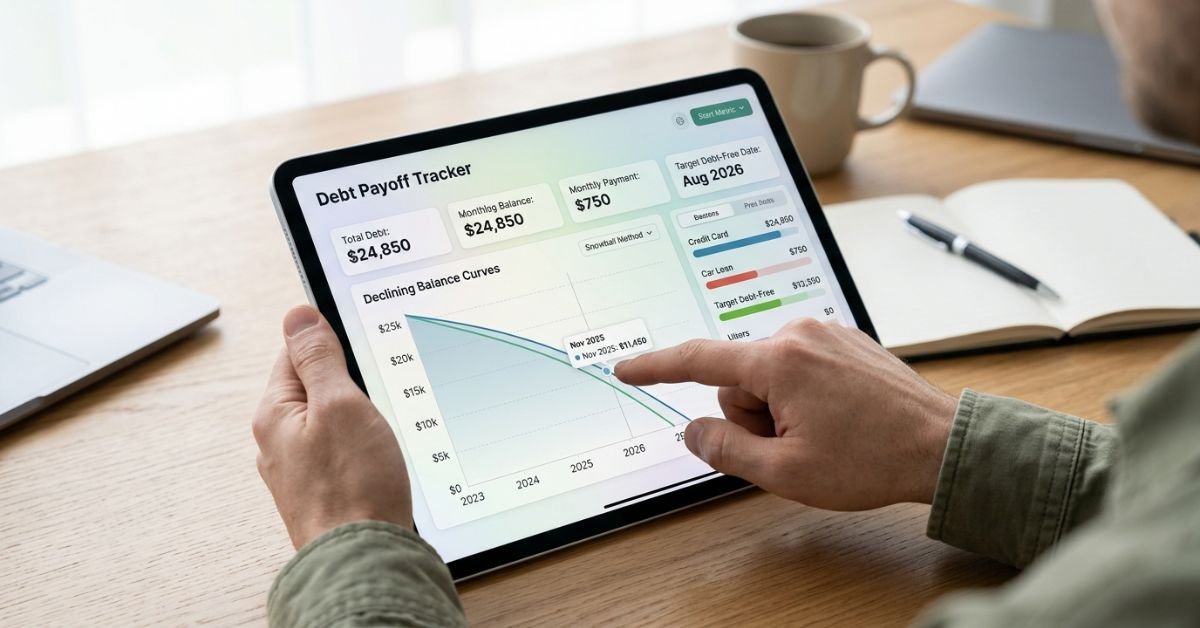
If you are looking for the best debt snowball calculator app, skip the generic ad-bloated downloads and look at Undebt.it. It’s a specialized, browser-based debt engine (with a clean mobile interface) that syncs via API directly to your accounts if you use YNAB.
With Undebt.it, you can run side-by-side simulations of the Avalanche method against the Snowball algorithm using your actual statement numbers:
- It tells you the exact month and year your balances drop to zero.
- It displays your exact total interest paid down to the cent.
- It adjusts automatically if a card has a promotional balance transfer APR that jumps up after 12 or 18 months.
Running my balances through Undebt.it showed me that switching from an ad-hoc repayment strategy to a pure automated avalanche schedule saved me $2,140 in pure finance charges over two years—without changing my income by a single penny.

3. Hands-On Micro-Payment Automation and Round-Up Tech
Waiting 30 days to make a single lump-sum credit card payment works against you. The US credit card system calculates finance charges based on your Average Daily Balance (ADB).
Every single day an unpaid balance sits on your revolving card, it accrues interest based on the card’s daily periodic rate (your APR divided by 365).
If you pay your balance down in fragments throughout the month rather than waiting for your statement due date, your ADB drops immediately. Lower average daily balance means less interest charged at the end of the billing cycle, which means more of your next payment attacks principal.
Bi-Weekly Payment Scheduling
One of the easiest tricks to pay off debt faster without a side hustle is converting from monthly payments to bi-weekly payment scheduling through your bank’s automated bill pay.
When you pay half of your monthly minimum every two weeks:
- You make 26 half-payments a year.
- That equals 13 full monthly payments annually instead of 12.
- That “ghost” extra payment happens naturally without feeling like you skimmed an extra chunk out of your budget, and it shaves months off an amortization schedule.
Automated Micro-Savings Routed to Debt
Fintech platforms made micro-transactions famous for investing, but the same mechanic crushes debt:
- Qapital and Oomph: Allow you to set algorithmic triggers (e.g., “every time I spend under my grocery budget, transfer the difference”).
- Round-Up Engines: Apps that monitor linked debit card purchases, round transactions to the nearest dollar, and accumulate the change.
Instead of holding round-ups in a 0.01% yield savings account, link the payout account to your highest-APR credit card via an automated weekly ACH push. Shoveling $40 to $70 a month in loose digital change onto a credit card cuts compounding interest down at the knees.
4. AI Bill Negotiation and Phantom Subscription Pruning
To redirect real cash to high-APR debt, you must locate the latent money already trapped inside your recurring baseline expenses. Most households carry between $150 and $300 a month in zombie subscriptions and overpriced utility rates.
Instead of sitting on hold with internet providers, telecom carriers, and utility companies, I deployed AI subscription cancellers and automated negotiation platforms.
Slicing Out “Zombie SaaS”
I hooked Rocket Money and Trim up to my primary transactional feeds via read-only Plaid connections. Within ten minutes, the software surfaced three services I hadn’t used in months:
- An expired cloud storage tier ($9.99/mo)
- A streaming package I thought I canceled after football season ended ($14.99/mo)
- A grandfathered gym add-on fee ($20.00/mo)
That’s $45 a month recovered instantly. Instead of absorbing that back into general spending, I immediately redirected that exact amount via an automatic recurring bill payment to my highest-interest card.
Automated Bill Negotiation Bots
Platforms like Rocket Money also feature bill negotiation agents. You upload a PDF copy of your broadband, cellular (AT&T, Verizon, T-Mobile), or home security bill.
Their system scans for available regional promotions, hidden equipment charges, and unbundled packages, then automatically negotiates lower rates on your behalf:
- They knocked my home broadband bill down by $25/month for 12 months with zero loss in bandwidth.
- They cut an extra line fee on my cellular plan, saving $35/month.
The Fee Catch: These platforms generally charge an upfront success fee (between 30% and 40% of the first year’s verified savings). Even with that cut, you are unlocking pure cash savings on services you already use, creating a fresh pipeline of capital to direct toward debt principal.
5. Real-World Tech Scenarios and Common Pitfalls to Avoid
To show how this functions in the wild, let’s look at a realistic scenario based on data I logged while helping a reader optimize their finances.
Case Study: Single Earner Household ($4,200/mo Net Income)
- Starting Debt: $18,200 across two cards (24.9% APR average) and one credit union personal loan (11% APR).
- Minimum Payments: $610/month.
- Initial Timeline: Over 9 years to debt freedom if paying minimums alone, with more than $14,000 paid in interest.
+---------------------------------------------------------------+
|             CASH REALLOCATION ENGINE (MONTHLY)                |
+----------------------------------------------------+----------+
| Optimization Lever                                 | Recovered|
+----------------------------------------------------+----------+
| AI subscription terminations (SaaS & streaming)    | +$62.00  |
| Telecom & broadband bill negotiation               | +$55.00  |
| Round-up micro-payment sweeps (Weekly cadence)     | +$78.00  |
| Converted bi-weekly payment schedule (Amortized)   | +$50.80  |
| Total Reallocated Capital (Zero New Income Needed) | $245.80  |
+----------------------------------------------------+----------+
By pushing an additional $245.80 every single month directly into the avalanche engine:
- Total repayment timeline dropped from 112 months down to 29 months.
- Total interest paid plummeted from ~$14,200 to under $4,900.
- Total cash saved: Over $9,300, without working a single hour of overtime or selling possessions.
Pro Tip: Watch Out for Predatory Consolidation Traps
Many debt consolidation apps you see advertised on social feeds are not software solutions—they are front-ends for high-origination-fee personal loans or aggressive debt settlement outfits. If an app advises you to default on payments so they can “negotiate settlements,” run. It will demolish your credit file for seven years. Stick to self-directed software, automated bank rails, and true 0% balance transfer APR promotions from reputable institutions.
Frequently Asked Questions
What are the best apps that automate debt payoff without needing extra deposits?
The most reliable platform setup is pairing a zero-based budgeting tool like YNAB or Monarch Money with a payoff tracker like Undebt.it. For direct automated micro-transfers, tools like Qapital allow you to sweep cash surpluses based on algorithmic rules without manual input.
Can I actually pay off credit card debt faster if my income is low?
Yes. Paying down debt on a low income relies on efficiency rather than sheer volume. By switching to bi-weekly payments, you reduce your Average Daily Balance and trigger 13 payments a year instead of 12. Combining that with aggressive APR reduction (via balance transfers or bill negotiation) ensures your dollars hit the principal instead of being absorbed by interest charges.
Is the debt avalanche method really better than the debt snowball algorithm?
Purely in terms of math, yes. The debt avalanche method mathematically guarantees that you will pay the absolute minimum amount of interest and finish repayment in the shortest possible timeframe. The debt snowball algorithm is only superior if you struggle with motivation and need immediate small wins to stick to your budget.
Do automated bill negotiation bots hurt my credit score?
No. Services like Rocket Money or Trim simply negotiate rates directly with service providers (internet, phone, utilities) on your current accounts. They do not close trade lines, open credit lines, or adjust the underlying credit accounts that feed into your credit bureau reports.
What should I do if my bank doesn’t support direct deposit splits?
If your employer’s payroll software doesn’t allow multiple direct deposit accounts, you can replicate the setup using a central digital checking account at an institution that supports automated scheduled transfers. From there, set up recurring ACH transfers to fire two business days after every payday to move money into your dedicated bills and debt-payoff accounts.