Grocery Shopping on $30 a Week: Tech-Backed Budget System.Three months ago, I stood in front of a supermarket self-checkout screen, staring at a total of $114.38. In my cart? A bag of honeycrisp apples, two chicken breasts, a carton of oat milk, some sourdough bread, and a few snacks. That food barely lasted me until Thursday.
- 1. Phase 1: The Initial Setup & The $4.28 Daily Constraint
- 2. 1. Active Pantry Inventory Management
- 3. 2. Bulk Staples Optimization
- 4. Phase 2: Sourcing via Algorithmic Aggregation
- 5. The Flipp App for Circular Scraping
- 6. The Flashfood Surplus App
- 7. Digital Coupon Clipping
- 8. Phase 3: In-Store Execution and Unit Price Economics
- 9. Mastering Unit Price Calculation
- 10. Barcode Scanner Shopping
- 11. The Nutrient-to-Cost Ratio
- 12. Phase 4: Dynamic AI Meal Generation and Cashback Loops
- 13. The Exact AI Meal Generation Prompt
- 14. Closing the Loop with Receipt Cashback Rebates
- 15. Pro Tip: The “First-In, First-Out” Freeze Hack
- 16. Costly Mistakes I Made Along the Way
- 17. Real-World $30 Basket Example (Standard Baseline)
- 18. Frequently Asked Questions
- 19. Can you actually get enough protein on $30 a week?
- 20. Does this system take hours of preparation every week?
- 21. What if my local stores don’t participate in apps like Flashfood?
- 22. How do you handle social dinners or eating out with friends?
- 23. Keeping the System Running
I was furious. Food inflation felt relentless, but as someone who spends their working hours automating software workflows, I realized I was approaching my grocery runs with zero strategy. I walked into stores blind, bought whatever looked appetizing, and let corporate marketing dictate my spending.
I decided to run an experiment: treat grocery procurement strictly like a supply chain problem. Could I eat balanced, filling meals on just $30 a week without feeling like I was living on plain instant ramen?
The answer is yes. You just have to swap emotional buying for algorithmic discipline. Here is the exact tech-driven framework I built to make it happen.


Phase 1: The Initial Setup & The $4.28 Daily Constraint
Thirty dollars over seven days gives you an operating budget of $4.28 per day, or about $1.42 per meal across three meals. If you try to pull this off by randomly roaming the aisles, you will fail before you make it past the bakery section.
Before downloading a single app or heading out the door, you need two foundational systems in place.


1. Active Pantry Inventory Management
Most people don’t overspend because groceries are expensive; they overspend because they buy duplicates of things already rotting in the back of their cabinets.
💰 More Cheap Living Tips You'll Love
- Debt Avalanche Method Step by Step: Fast Debt Payoff
- Debt Snowball Method: How It Works (With Real Example)
- Debt Snowball on a Low Income: Does It Still Work in 2026-27?
- Pay Off Debt Faster Without Earning More: Tech Guide
- Save Money or Pay Off Debt First? Tech-Driven Guide
- Debt Snowball vs Avalanche: Which Repayment Strategy Wins?
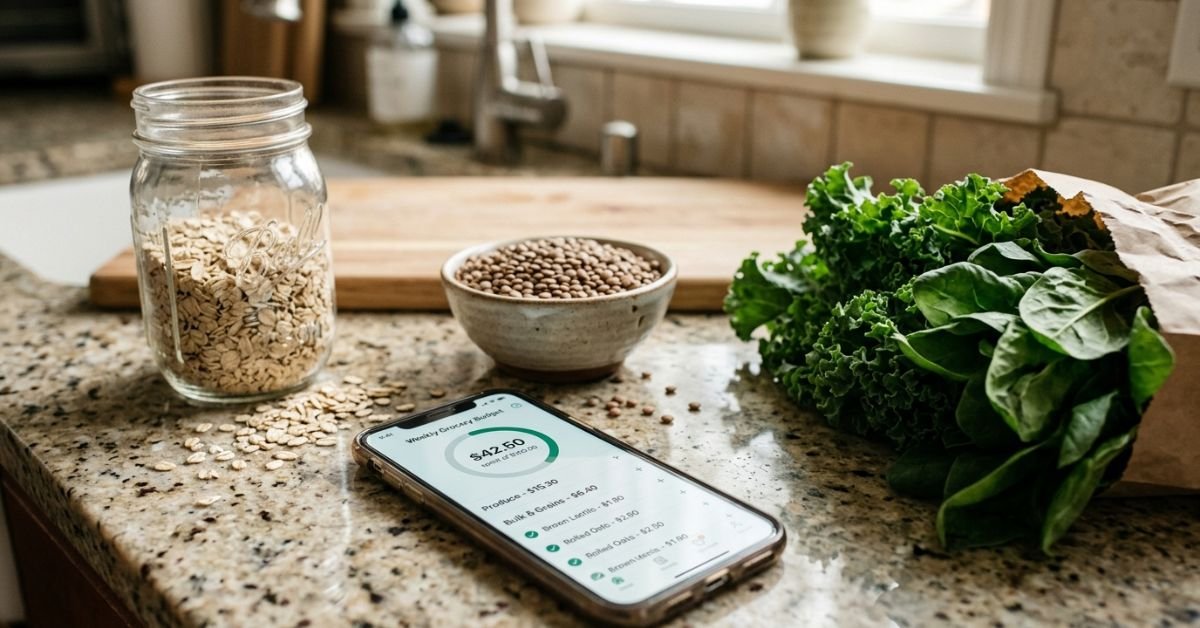
I run a stripped-down database in Notion (a basic Google Sheet works just as well) divided into three columns:


- Base Carbs & Starches (Rice, flour, oats, pasta, potatoes)
- Proteins & Fats (Dry lentils, eggs, peanut butter, cooking oil)
- Flavor & Acid (Spices, vinegar, soy sauce, garlic, hot sauce)
Every Sunday, I spend four minutes checking shelf levels. Anything marked “Full” is off-limits for that week’s grocery list. You are not starting from zero every week; you are operating on a rolling restocking schedule.
2. Bulk Staples Optimization
You cannot buy a full pantry on $30. If your $30 has to cover an entire tub of olive oil, five pounds of salt, and a fresh carton of eggs on week one, you won’t have enough money left for calories.
The secret is bulk staples optimization. Treat your pantry items as capital investments amortized across 4 to 8 weeks. In week one, $5 of your $30 buys a 5-pound bag of rice that lasts a month. That breaks down to roughly $1.25 per week in actual food consumption. The rest of your weekly cash flow targets perishables and fresh additions.
Phase 2: Sourcing via Algorithmic Aggregation
Supermarkets spend billions on behavioral psychology to trick your brain into impulse buys. My countermeasure? Never look at physical store shelves until I’ve already run the weekly data through three specific apps.
Weekly Procurement Stack:
├── Discovery: Flipp (Circular Aggregation & Digital Coupons)
├── Rescue: Flashfood / Too Good To Go (Near-expiry proteins & produce)
├── Pricing Audit: Store-specific Barcode Scanners (Unit cost verification)
└── Planning: Local LLM / ChatGPT (Recipe compilation based on inventory)
The Flipp App for Circular Scraping
Print circulars are dead. The Flipp app aggregates weekly circulars from discount grocers within a 10-mile radius (Aldi, Lidl, local independent ethnic supermarkets, and regional discounters).
Instead of browsing aimlessly, I search by core ingredient. Type in “eggs,” “cabbage,” or “chicken drumsticks,” and Flipp compares regional sales side-by-side. I look exclusively for loss leaders—deeply discounted proteins and staples stores sell below cost just to get you through their doors.
The Flashfood Surplus App
Meat is the absolute budget killer on a $30 limit. If you pay full retail price ($4.99–$6.99/lb for poultry or ground beef), half your weekly budget vanishes on two dinners.
I check the Flashfood surplus app twice daily (8:00 AM and 2:00 PM). Supermarkets use Flashfood to unload meat, dairy, and produce boxes that have 24 to 48 hours left before their “best-by” date. I routinely pull three pounds of chicken thighs or lean beef at a 50% discount.
The immediate workflow: bring it home, vacuum seal or wrap it tightly, and put it directly into the freezer. You bypass the retail markup completely without compromising food safety.
Digital Coupon Clipping
Sign into your grocer’s native app (Kroger, Target, Meijer, or regional equivalents) and search the digital savings hub. Digital coupon clipping is no longer scissors-and-paper work; you simply tap “clip” to attach the discount to your phone number.
I stack manufacturer discounts on top of weekly store markdowns. If canned black beans are marked down to $0.79 and there is a digital coupon for $0.50 off two, that drops my unit cost down to pennies.
Phase 3: In-Store Execution and Unit Price Economics
Once you cross the store threshold, emotions try to take over. You smell fresh rotisserie chicken or see brightly colored end-caps screaming “BUY 2 GET 1 FREE.”
Ignore all of it. End-caps exist to clear high-margin inventory, not to save you money.
Mastering Unit Price Calculation
Retailers manipulate package sizes to hide price hikes (shrinkflation). A “sale” price of $2.99 might look cheaper than a standard box at $3.49, but the $3.49 option could give you twice the volume.
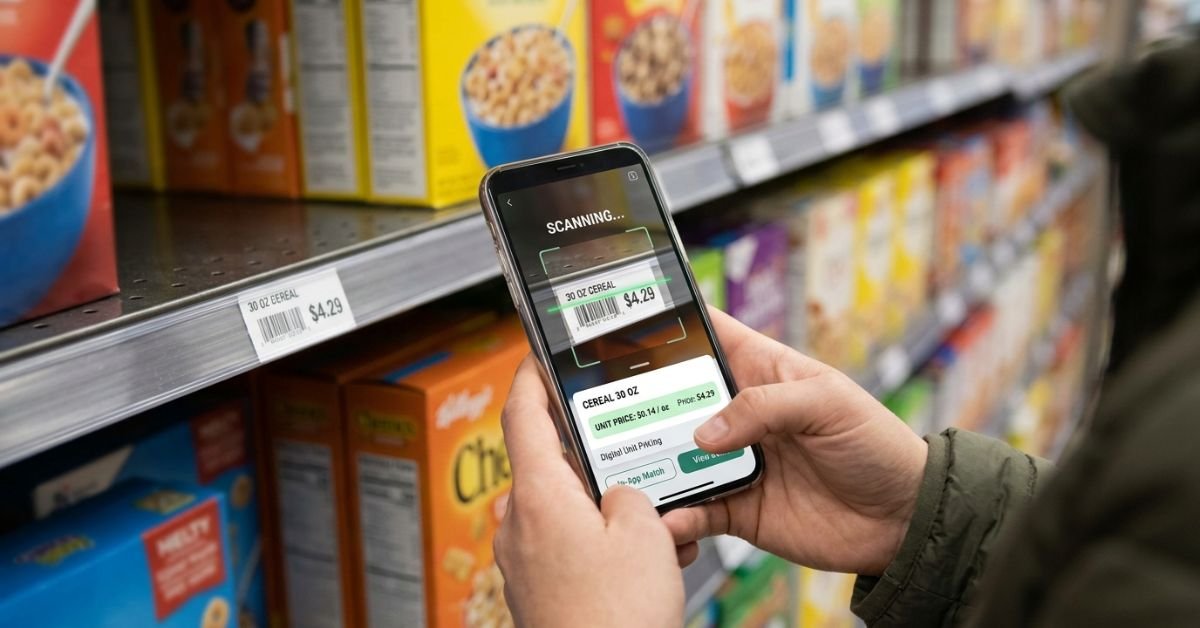
Always look at the bottom-left or bottom-right corner of the shelf tag: the unit price calculation (cost per ounce, per gram, or per pound).
$$\text{Unit Price} = \frac{\text{Total Retail Price}}{\text{Net Weight / Quantity}}$$
- Example: A 16 oz jar of peanut butter costs $2.40 ($0.15/oz). A 40 oz jar costs $4.80 ($0.12/oz).
- Over a month, that three-cent difference per ounce compounds. If you have the buffer in your rolling budget, prioritize the lowest unit price every time.
Barcode Scanner Shopping
Most national grocery chains now include an in-app scanner. As I place items into my cart, I run them through the barcode scanner shopping tool on my phone.
This accomplishes two critical jobs:
- It instantly flags unadvertised digital coupons I might have missed.
- It gives me a live running total including estimated local sales tax.
If my running tally hits $29.10, I am done. There is no guessing game at the register. No awkward moments where I have to ask the cashier to put an item back.
The Nutrient-to-Cost Ratio
On an ultra-lean budget, every cent must carry nutritional weight. I evaluate every potential purchase by its nutrient-to-cost ratio—prioritizing items that deliver high protein, slow-digesting complex carbohydrates, and micronutrients per dollar spent.
| Item Category | Target Foods | Avg. Cost / Pound | Nutritional Payoff | | :— | :— | :— | :— | | High-Yield Legumes | Dry green lentils, black beans | $1.20 – $1.40 | High plant protein, dietary fiber, iron | | Heavy Cruciferous | Green cabbage, whole carrots | $0.69 – $0.89 | Dense volume, Vitamin C, lasts weeks in the crisper | | Complete Carbs | Rolled oats, brown rice, whole potatoes | $0.80 – $1.10 | Sustained energy, high satiety index | | Budget Proteins | Large eggs, canned tuna, bone-in chicken thighs | $1.50 – $2.20 | Complete amino acid profiles, essential fats |
Notice what is missing? Bagged salad mixes, pre-cut vegetables, branded breakfast cereals, and soda. Bagged spinach turns to liquid in four days; a whole head of green cabbage stays crisp in your fridge for three weeks and yields five times the volume per dollar.
Phase 4: Dynamic AI Meal Generation and Cashback Loops
You got home. You stayed under $30. Now comes the part where most people fail: eating weird, disjointed meals until they give up and order takeout.
This is where generative AI shines.
The Exact AI Meal Generation Prompt
Instead of searching bloated recipe blogs stuffed with twenty pages of life stories, I plug my exact haul into an LLM (ChatGPT, Claude, or any local offline model).
Here is the exact prompt template I run every Sunday night:
“I have a fixed grocery pantry this week. I cannot buy anything else. Here is my exact inventory: [List your store haul + your base pantry items]. Generate a 7-day meal plan (breakfast, lunch, dinner) that ensures zero food waste. Prioritize high-protein and high-fiber combinations. Provide simple prep steps and list which ingredients carry over between meals.”
The model will spit out meal variations you wouldn’t intuitively consider: lentil-potato hash with fried eggs, savory oatmeal bowls topped with soy-braised cabbage, or shredded chicken fried rice. It turns random low-cost ingredients into a cohesive, structured culinary plan.
Closing the Loop with Receipt Cashback Rebates
Don’t throw your paper receipt away or close your digital invoice.
I immediately pass my receipt through three micro-earning platforms:
- Fetch Rewards (Point collection on any grocery receipt)
- Ibotta (Direct cash returns on specific staples and brand items)
- Checkout 51 (Secondary rebate layer)
Does scanning a receipt make you rich? No. But pulling in $1.50 to $3.00 every week via a receipt cashback rebate effectively gives you an extra 5% to 10% discount on your entire $30 weekly food budget. That cashback sits in an app wallet until it funds an entire week of groceries every couple of months.
Pro Tip: The “First-In, First-Out” Freeze Hack
Fresh greens and clearance meat don’t wait for your schedule. The moment you process groceries, cut raw veggies (like onions, peppers, or softening carrots) and stash them into portioned freezer bags. Take clearance meats, add a tablespoon of basic pantry oil and whatever spice blend you have, and freeze them in flat marinades. You prevent spoilage before it starts, locking your food waste at flat zero.
Costly Mistakes I Made Along the Way
This system wasn’t born out of flawless execution; it came from multiple annoying failures.
- The Calorie Deprivation Mistake: In my second week, I bought only cucumbers, celery, low-calorie greens, and broth because they were cheap. By Wednesday night, I had a blinding headache, zero energy, and ended up eating four spoonfuls of peanut butter at midnight. Bulk carbs and fats (potatoes, rice, oats, oil) are not optional—they are your caloric engine.
- Falling for “Cheap” Junk: Just because a box of off-brand cookies costs $0.99 doesn’t mean it belongs in a $30 system. It has a miserable nutrient-to-cost ratio. You will be hungry thirty minutes after eating it.
- The “Discount Overload” Trap: I once bought eight bunches of clearance bananas on Flashfood for $2.00. I couldn’t eat or freeze them fast enough. Half of them attracted fruit flies and went into the compost bin. A discount is only savings if you actually consume it.

Real-World $30 Basket Example (Standard Baseline)
To see how this works in practice, here is a breakdown of an actual basket I purchased recently using these tools:
- 5 lbs Russet Potatoes: $3.49 (Massive starch base, high potassium, deeply filling)
- 1 lb Dry Brown Lentils: $1.39 (Yields roughly 6-7 cups of cooked protein)
- 1 Dozen Large Eggs: $2.29 (Complete protein, essential fats)
- 1 Large Head of Green Cabbage: $1.89 (Micronutrients, roughage, lasts forever)
- 3 lbs Chicken Drumsticks (On Sale via Flipp): $4.47 ($1.49/lb)
- 1 lb Rolled Oats: $1.65 (Breakfast base for 10+ days)
- 1 Bag of Carrots (2 lbs): $1.79 (Raw snacks or roasted flavor base)
- 2 Cans Crushed Tomatoes: $1.98 (Sauce base for lentils and curries)
- 1 Block of Medium Cheddar (8 oz): $2.19 (Fat, protein, flavor punch)
- 1 Loaf Whole Wheat Bread (Store Brand): $1.79 (Complex carbs)
- Flashfood Veggie Rescue Box: $5.00 (Assorted mixed peppers and squash)
- Tax / Buffer: $2.07
- Total Spent: $30.00
Combined with existing pantry staples (cooking oil, salt, garlic powder, soy sauce), this inventory builds hearty, nutritionally sound meals for seven straight days.
Frequently Asked Questions
Can you actually get enough protein on $30 a week?
Yes, but you have to shift away from prime cuts of meat like ribeye, salmon, or boneless skinless chicken breasts. Rely heavily on dry lentils (roughly 50 grams of protein per pound dry), large eggs, canned sardines or tuna, and cheaper poultry cuts like bone-in chicken thighs or drumsticks. Stacking plant and animal proteins guarantees you hit 70 to 90 grams of protein per day easily.
Does this system take hours of preparation every week?
In the beginning, plan on spending about 30 to 45 minutes on the weekend setting up your Flipp alerts, checking Flashfood, and running your prompt through AI. Once your templates are built, the entire planning workflow takes under 15 minutes on Sunday morning. In-store shopping actually becomes faster because you enter the building with a strict, non-negotiable list.
What if my local stores don’t participate in apps like Flashfood?
If rescue apps aren’t active in your zip code, identify the markdown schedule of your local grocer manually. Ask the meat or dairy department manager what time they apply yellow “manager special” clearance stickers to inventory. Most chains do this either late in the evening (after 7:00 PM) or first thing in the morning (around 7:30 AM). Show up during those windows to get the same 30% to 50% discounts.
How do you handle social dinners or eating out with friends?
This $30 framework covers your baseline fuel at home. If you want to grab dinner or drinks with friends, fund that from a separate “entertainment” bucket in your budget. Do not compromise your daily nutrition to pay for a restaurant meal; treat this system as your predictable, non-negotiable living baseline.
Keeping the System Running
Cutting your grocery bill to $30 a week isn’t about ascetic self-denial. It is about removing the friction, waste, and marketing tricks that quietly siphon money out of your account every single month.
When you track unit economics, let software source the discounts, and rely on AI to build your weekly plans, you take control back from the supermarket algorithms. Try running this exact setup for just two weeks. Check your bank balance at the end. The numbers will speak for themselves.