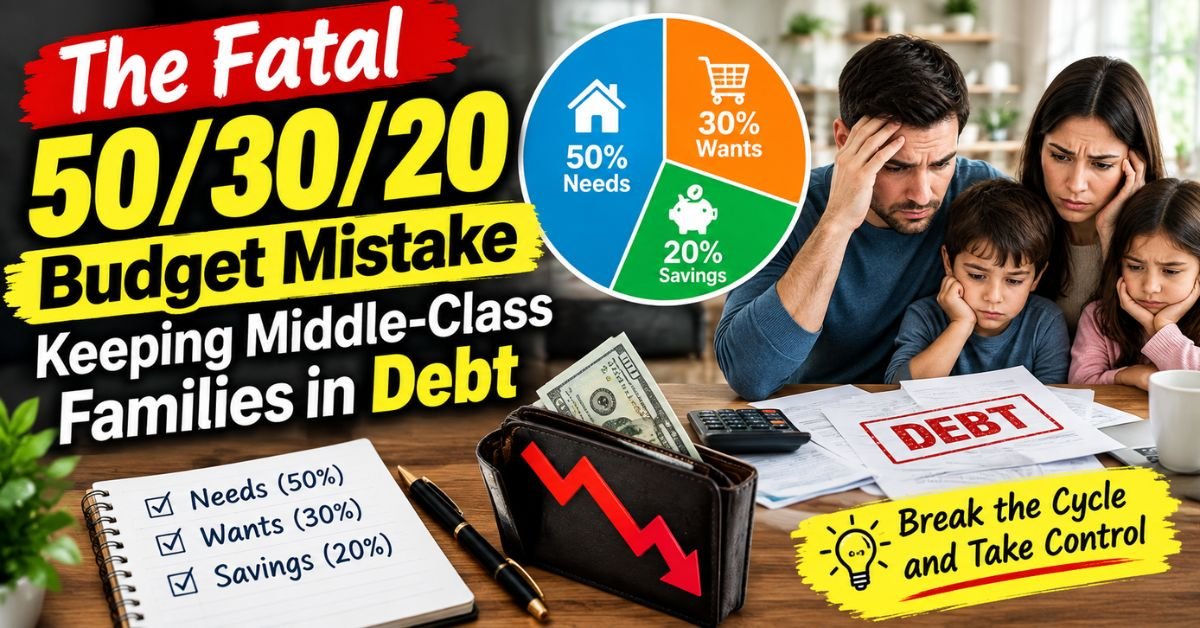
The Fatal 50/30/20 Budget Mistake Keeping Middle-Class Families in Debt.Three years ago, I sat across the kitchen table from a couple in suburban Columbus, Ohio. Both worked solid corporate jobs, bringing home a combined $95,000 a year—comfortably above the U.S. median household income of $74,580. Yet, they were drowning. They were juggling $18,400 across three separate cards, with interest rates ticking well over 24%.
- 1. The Allure and The Illusion: Deconstructing the 50/30/20 Rule
- 2. The Critical Trap: Treating Minimum Payments as “Needs”
- 3. Real-World Case Study: The Miller Household
- 4. The Stagnant Period: The Standard 50/30/20 Approach (18 Months)
- 5. The Escape: The Inverted Velocity Model (11 Months)
- 6. Common Pitfalls When Applying Outdated Ratios to Modern Expenses
- 7. Hands-On Blueprint: The “Inverted Velocity” Debt Budget Protocol
- 8. Step 1: Establish a Fixed Micro-Buffer
- 9. Step 2: Compress Wants to a Fixed Floor (5% to 10%)
- 10. Step 3: Attack Principal with the Debt Avalanche
- 11. Step 4: Automate via Financial Aggregators
- 12. Expert Insight: The Real Cost of “Balanced” Budgeting
- 13. Transitioning from Survival to Sustainability: Post-Debt Budgeting
- 14. Frequently Asked Questions
- 15. Why does the 50/30/20 rule fail for people living in high-cost-of-living areas?
- 16. How much of my monthly budget should actually go toward paying off credit card debt?
- 17. Should I stop contributing to my 401(k) while paying down high-interest credit card debt?
- 18. What is the difference between the Debt Snowball and Debt Avalanche methods?
- 19. Can I include my minimum student loan or auto loan payments in my “Needs” category?
They were stressed, exhausted, and confused because they had spent two straight years following the golden child of personal finance: the 50/30/20 rule.
They tracked every dollar. They dutifully designated 50% to needs, 30% to wants, and 20% to savings and debt. But their principal balances barely budged.

The math should have worked on paper. In reality, it was keeping them locked in an expensive financial holding pattern. There is a quiet, structural flaw embedded within the standard 50/30/20 framework—one that turns modern American credit card debt into an almost permanent fixture of middle-class life.
The Allure and The Illusion: Deconstructing the 50/30/20 Rule
When Senator Elizabeth Warren and her daughter Amelia Warren Tyagi popularized the framework in their 2005 book, All Your Worth: The Ultimate Lifetime Money Plan, the economic landscape looked radically different.
Back then, the national cost of living index was manageable. A starter home in Raleigh or Phoenix didn’t require two executive-level salaries, private childcare didn’t rival in-state university tuition, and the federal funds rate had anchored credit card interest rates somewhere near sanity.
The formula is universally known:
- 50% Needs: Rent/mortgage, utilities, basic groceries, minimum debt obligations.
- 30% Wants: Dining out, vacations, streaming services, hobbies.
- 20% Savings & Debt: Extra debt payments, 401(k) contributions, building cash buffers.
Fast-forward to today. The Federal Reserve’s G.19 Consumer Credit report shows revolving credit balances topping all-time records, while the commercial bank average credit card APR swings between 21.5% and 24.8%. For people with average credit scores, retail and co-branded cards regularly hit 29.99%.
Traditional 50/30/20 Allocation:
┌───────────────────────────────┬───────────────────────────────┐
│ Needs (50%)                   │ Wants (30%)                   │
│ Housing, Groceries, Min Debt  │ Dining, Travel, Hobbies       │
├───────────────────────────────┴───────────────────────────────┤
│ Savings & Debt (20%)                                          │
│ Extra Debt Payments, Emergency Fund, 401(k)                   │
└───────────────────────────────────────────────────────────────┘
Here is why 50 30 20 doesn’t work for debt when rates are this toxic: the framework lumps extra debt repayment into that tiny 20% slice alongside cash savings and retirement contributions.
💰 More Cheap Living Tips You'll Love
- Hidden Medical Bill Errors You Must Dispute Immediately to Save Big
- Costly Car Ownership Mistakes That Secretly Drain Your Budget Every Month
- Practical Ways to Eat Healthy on a Bare-Bones $50 Weekly Budget
- The Real Cost of Daily Convenience Habits That Steal Thousands Every Year
- Dangerous Lifestyle Creep Signs That Are Quietly Keeping You Broke
- How to Stop Impulse Buying Forever with the Seven-Day Rule
If your monthly take-home pay is $5,000, that 20% equals $1,000. If you split that between emergency fund capitalization, a basic employer match on your 401(k), and an extra payment toward an $18,000 credit card balance, your debt principal only sees $300 to $400 a month.
At a 24% credit card APR, that $18,000 balance racks up $360 in interest charges alone every single month. Your “extra” payment isn’t cutting down the balance; it’s merely paying the bank’s processing fee to keep you on the hamster wheel.
The Critical Trap: Treating Minimum Payments as “Needs”
The most damaging misinterpretation of the 50/30/20 rule lies in how people categorize their monthly debt payments. Most people naturally lump minimum monthly debt obligations into the “50% Needs” category because missing them wrecks their credit scores. Then, they put any extra principal payments into the “20% Savings/Debt” bucket.
This is a disastrous psychological error.
When you classify a minimum credit card payment as a “need” alongside shelter, water, and groceries, you normalize a high-interest consumer liability as a permanent operational utility. It becomes part of your baseline living cost, no different than an electric bill.
Traditional underwriting standards might consider those minimums as fixed liabilities when evaluating your debt-to-income ratio (DTI), but your personal balance sheet should treat them as an active financial emergency.
By hiding the minimum payment inside the “Needs” bucket, households give themselves psychological permission to spend the full 30% on “Wants.” They convince themselves they are living responsibly because their lifestyle costs stay inside the target percentages, all while their revolving credit lines steadily siphon thousands of dollars in interest out of their accounts.
Real-World Case Study: The Miller Household
Let’s look at the couple I mentioned earlier—Mark and Sarah Miller. They live just outside Columbus with two young children.
- Gross Household Income: $95,000
- Net Monthly Take-Home Pay: $5,600 (after taxes, health insurance, and modest 401(k) matches)
- Unsecured Debt: $18,000 spread across two credit cards (Weighted APR: 23.4%)
- Required Minimum Payments: ~$540/month
The Stagnant Period: The Standard 50/30/20 Approach (18 Months)
For a year and a half, the Millers followed traditional guidelines. Here is what their monthly ledger looked like:
| Category | Budgeted % | Budgeted $ | What It Actually Covered | | :— | :— | :— | :— | | Needs | 50% | $2,800 | Mortgage ($1,650), Utilities ($310), Groceries ($500), Min Credit Card Dues ($540) — (Over by $200) | | Wants | 30% | $1,680 | Family outings, streaming, kid activities, dining out, casual Target runs | | Savings/Debt | 20% | $1,120 | $400 to savings, $320 to high-deductible HSA buffer, $400 extra debt payment |
Notice what happened? Because their needs ran higher than 50% (a common reality for anyone dealing with 50 30 20 rule high cost of living challenges), they quietly squeezed their debt repayment to maintain their 30% lifestyle.
With $540 in minimums and $400 in extra principal payments, they paid $940 monthly toward their debt. But at 23.4% interest on an $18,000 balance, roughly $350 was lost to finance charges every single month. After 18 months of discipline and sacrifice, they had paid more than $16,900 to the credit card companies, yet their remaining principal still sat at a painful $13,200.

The Escape: The Inverted Velocity Model (11 Months)
We completely abandoned the traditional 50/30/20 ratios. We audited their fixed vs discretionary expenses, paused their non-matched savings allocations, and temporarily compressed their “Wants” down to a strict bare-bones allowance.
Instead of asking, “how to pay off debt with 50 30 20 rule?” we asked, “how much of budget should go to credit card debt to kill this balance in under a year?”
- Modified Needs (55%): $3,080 (Shelter, basic groceries, utilities, auto insurance—zero debt minimums included here).
- Compressed Wants (8%): $450 (A tight sanity fund so they didn’t burn out).
- Debt Velocity Allocation (37%): $2,070 sent directly to the principal balances using the Debt Avalanche method (targeting the 26% card first).
The outcome? The Millers erased the remaining $13,200 in just under seven months. In total, they were out of debt in 11 months from the day they switched frameworks. They saved over $3,800 in interest charges compared to their original track.
Common Pitfalls When Applying Outdated Ratios to Modern Expenses
The reality is that budgeting when needs are more than 50 percent is the baseline experience for millions of working families today. Suburban cost pressures are relentless:
- Suburban auto financing routinely demands $600 to $900 per vehicle.
- Medical deductibles under standard high-deductible health plans (HDHPs) routinely run $3,000 to $7,000 per year out-of-pocket before insurance covers a dime.
- Childcare easily runs $1,200 to $1,800 a month per child in major metropolitan hubs.
When you try to force modern expenses into an arbitrary 50% box, something breaks. Most people give up on budgeting entirely, or they keep the 30% “Wants” intact because life feels stressful enough already, letting high-interest balances fester.
Another major misstep: prioritizing taxable investing over toxic debt. I frequently run into folks putting $200 a month into an index fund returning an annualized 8% to 10% in the S&P 500, while carrying revolving balances compounding against them at 24%. That is a guaranteed net loss of 14% to 16% on every dollar. Mathematically, it makes zero sense.
Hands-On Blueprint: The “Inverted Velocity” Debt Budget Protocol
If you are looking for viable alternatives to 50 30 20 budget models while sitting on high-interest consumer balances, here is the exact protocol I use with private clients.
The Inverted Velocity Strategy:
Step 1: Cap liquid emergency buffer at $2,500
Step 2: Compress Wants to 5-10% of net income
Step 3: Direct 30-40%+ of cash flow directly to principal balances
Step 1: Establish a Fixed Micro-Buffer
Stop trying to build a 6-month emergency fund while holding 20%+ APR debt. Park a flat $2,000 to $2,500 in a high-yield savings account (HYSA). This exists solely to absorb minor emergencies—a flat tire, an unexpected urgent care co-pay—so you don’t reach for plastic. Every other spare dollar goes to principal.
Step 2: Compress Wants to a Fixed Floor (5% to 10%)
Do not strip your life down to absolute misery. Total deprivation leads directly to spending benders. Give your household a non-negotiable cash allowance—say, $75 to $100 a week—for sanity. Once it’s gone, the dining room table is your restaurant.
Step 3: Attack Principal with the Debt Avalanche
List every card, balance, and APR. Pay the legal minimum on all cards except the one with the highest interest rate. Channel every last dollar of free cashflow into that top-interest balance. Once it hits zero, roll that entire monthly sum into the next highest rate card.
Step 4: Automate via Financial Aggregators
Stop relying on mental accounting. Connect your accounts to platforms like Monarch Money, YNAB (You Need A Budget), or even an automated Google Sheet using Tiller. Set automated transfers on payday so you never see the debt repayment capital sitting in your primary checking account.
Expert Insight: The Real Cost of “Balanced” Budgeting
“The biggest disservice the modern personal finance industry does to middle-class households is peddling balance during a financial emergency. If your house is on fire, you don’t allocate 30% of your water hose to watering the lawn. A 25% APR credit card balance is an emergency. Treat it like one: drown it with every scrap of cash you can find, then go back to balance once the fire is out.” — AFC / CFP Professional Practice Note

Transitioning from Survival to Sustainability: Post-Debt Budgeting
The “Inverted Velocity” method is an emergency sprint, not a marathon. Living on compressed discretionary allocations for years isn’t realistic, nor is it healthy.
Once your high-interest revolving credit lines are completely at zero, you can transition back into a sustainable, long-term framework. This is the moment where the 50/30/20 rule actually works.
Now that the minimum debt payments and finance charges are gone, that 20% bucket can do what Elizabeth Warren originally intended:
- Fund your real emergency reserves: Expand your $2,500 micro-buffer into a robust three- to six-month emergency fund.
- Maximize retirement: Max out your Roth IRA or crank up your 401(k) contributions to take full advantage of compounding returns.
- Fund sinking reserves: Pre-fund auto repairs, medical deductibles, and home maintenance so you never have to carry a balance again.
You can safely expand your “Wants” back up to 20% or 30% without an ounce of guilt. You aren’t subsidizing lifestyle creep with high-interest debt anymore; you are funding your life with actual, permanent margin.
Frequently Asked Questions
Why does the 50/30/20 rule fail for people living in high-cost-of-living areas?
In major metropolitan hubs or high-cost suburban markets, essential living costs (rent or mortgage payments, local property taxes, private childcare, and auto insurance) frequently consume 60% to 70% of a family’s take-home pay. Trying to force those basic survival costs into a strict 50% cap leaves households feeling like failures, often causing them to abandon budgeting altogether while relying on credit cards to bridge the gap.
How much of my monthly budget should actually go toward paying off credit card debt?
If you carry high-interest revolving balances (anything over 15% APR), you should temporarily allocate as much cashflow as humanly possible—often 30% to 40% of your take-home pay—toward principal payments. Limiting debt reduction to a tiny fraction of your monthly income allows compounding interest charges to consume most of your payments, prolonging your payoff timeline by years.
Should I stop contributing to my 401(k) while paying down high-interest credit card debt?
You should almost always contribute enough to capture any direct employer match (for example, putting in 4% to get a 4% match), as that is an immediate 100% return on your money. However, contributions above the match should generally be paused temporarily. The guaranteed 20% to 29% return you get by eliminating credit card interest heavily outperforms historic stock market averages.
What is the difference between the Debt Snowball and Debt Avalanche methods?
The Debt Snowball method targets your smallest balances first to build quick psychological wins, regardless of interest rates. The Debt Avalanche method focuses all extra cash on the debt carrying the highest interest rate (APR). Mathematically, the Debt Avalanche saves the most money and clears debt the fastest, though the Snowball method can be useful if you need immediate motivation to stay on track.
Can I include my minimum student loan or auto loan payments in my “Needs” category?
Fixed-rate installment loans with moderate interest rates (like a 4% student loan or a 5% fixed auto loan) can reasonably sit within your “Needs” category, as their balances don’t compound exponentially like revolving credit cards. However, if an auto payment exceeds 10% to 15% of your take-home pay, it represents an underlying spending mismatch that should be addressed directly.