Hidden Medical Bill Errors You Must Dispute Immediately to Save Big.Two years ago, I opened my mailbox to find a crisp, white envelope from an outpatient surgical center. Inside was a bill for $3,842.10. My stomach instantly dropped.
- 1. The Reality of Medical Billing: Why 80% of Invoices Contain Mistakes
- 2. The Top 5 Hidden Medical Bill Errors Costing You Thousands
- 3. 1. Upcoding (Inflating Routine Visits)
- 4. 2. Unbundling (Slicing Packaged Services into Separate Fees)
- 5. 3. Phantom Charges and Ghost Supplies
- 6. 4. Duplicate Billing Across Facilities and Providers
- 7. 5. In-Network Facility with Out-of-Network Clinicians
- 8. Real-World Case Study: Dissecting an Exorbitant Emergency Room Invoice
- 9. Hands-On Step-by-Step Blueprint to Auditing and Disputing Your Bill
- 10. Step 1: Demand the Fully Coded Itemized Bill
- 11. Step 2: Cross-Examine with Your Explanation of Benefits (EOB)
- 12. Step 3: Verify Fair Market Rates
- 13. Step 4: Dispute Wrong CPT Codes and File Written Objections
- 14. Federal Shields & Negotiation Leverage: The No Surprises Act and Charity Care
- 15. The 2022 No Surprises Act
- 16. Enforcing IRS Section 501(r) Non-Profit Charity Care
- 17. Can You Negotiate Hospital Bills After Insurance Pays?
- 18. Common Pitfalls When Challenging Medical Debt
- 19. 1. Slapping the Balance on a Credit Card
- 20. 2. Panicking Over Short-Term Credit Score Impact
- 21. 3. Relying on Verbal Agreements
- 22. Frequently Asked Questions
- 23. What should I do if a hospital sends my disputed bill to a collection agency?
- 24. Can a hospital refuse to treat me if I am disputing an old medical bill?
- 25. How long does a hospital billing audit typically take?
- 26. What is the difference between a deductible, coinsurance, and a copay?
- 27. When should I consider hiring a professional Medical Billing Advocate?
According to the summary page, my insurance had covered their portion, leaving me on the hook for a massive deductible and coinsurance balance. I had already hit what I assumed was my out-of-pocket maximum for the year, so the figure made zero sense.
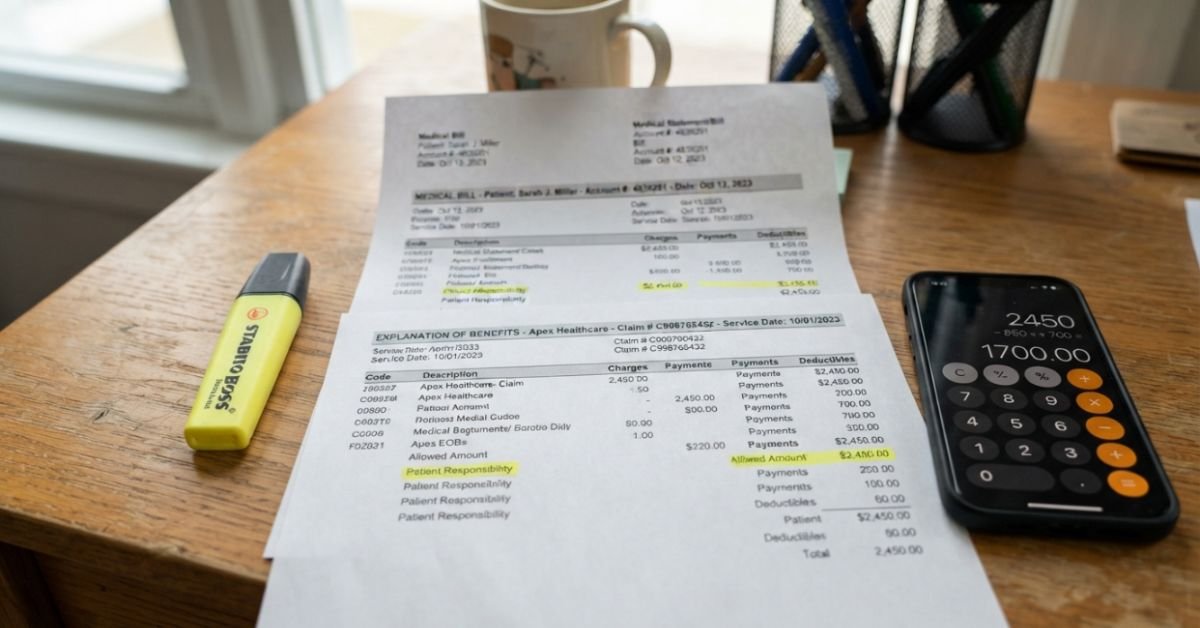
Instead of writing a check or panicking, I picked up my phone, grabbed a highlighter, and treated that document like a suspicious software log. What I found was startling: $1,400 for a “surgical tray” I never saw, a duplicate charge for a local anesthetic, and an inflated physician service code. After three weeks of phone calls and a formal dispute letter, my revised bill came out to exactly $214.50.
If you live in the United States, this isn’t an anomaly. It’s standard operating procedure.


The Reality of Medical Billing: Why 80% of Invoices Contain Mistakes
Billing advocates frequently quote an uncomfortable statistic: roughly 70% to 80% of medical bills in the U.S. contain errors. Having audited dozens of bills for friends, family, and readers, I’m convinced that number might actually be conservative.
Why is the system so dysfunctional? Hospitals and clinic networks don’t run on simple price tags. They use a massive internal price list called a Chargemaster—an arbitrary catalog of inflated sticker prices that no commercial insurer ever pays in full.


When you leave an appointment or discharge from a hospital, coders translate clinical notes into alphanumeric billing codes. If a physician’s note is vague, an automated billing algorithm or an overzealous coder picks the highest allowable code. Add rushed administrative staff, complex software integrations, and fragmented departmental billing systems, and the result is an invoice riddled with glitches.
💰 More Cheap Living Tips You'll Love
- Dangerous Lifestyle Creep Signs That Are Quietly Keeping You Broke
- How to Negotiate Your Internet Bill Down Without Threatening to Cancel
- Smart Bank Account Structuring Strategies to Automate Wealth Building
- Costly Car Ownership Mistakes That Secretly Drain Your Budget Every Month
- How a Mid-Year Financial Reset Can Completely Transform Your Savings (Step-by-Step Guide)
- The High-Yield Savings Account Strategy That Makes Passive Cash Daily
The fundamental trap is the summary invoice. That one-page sheet you get in the mail with vague labels like “Pharmacy: $1,280” or “Lab Services: $640” is deliberately opaque. It is not an invoice designed for customer verification; it’s an invitation to pay without asking questions.


The Top 5 Hidden Medical Bill Errors Costing You Thousands
If you want to know how to check if medical bill is accurate, you need to recognize the specific patterns billing departments use that silently drain your bank account.
1. Upcoding (Inflating Routine Visits)
Upcoding occurs when a healthcare provider assigns a code for a more complex, expensive treatment than the one you actually received.
In an emergency department, evaluation and management services are graded on five levels using Current Procedural Terminology (CPT) Codes:
- CPT 99281–99282: Minor issues (a simple rash or suture removal).
- CPT 99283: Moderate severity (sprains, minor lacerations requiring basic closure).
- CPT 99284–99285: High-severity, life-threatening complications requiring immediate physician intervention.
Hospitals frequently bill standard sprains or simple viral infections at a Level 4 (99284) or Level 5 (99285). You might have spoken to a physician assistant for three minutes, yet the hospital billed you for comprehensive critical care decision-making.
2. Unbundling (Slicing Packaged Services into Separate Fees)
Surgical procedures and complex diagnostic workups are typically assigned comprehensive, bundled package codes. Under billing standards maintained by the American Medical Association (AMA) and the Centers for Medicare & Medicaid Services (CMS), these bundled codes cover the incision, local anesthesia, surgical supplies, and simple wound closure.
Unbundling is the illicit practice of carving out pieces of that all-inclusive code and billing them individually to increase total reimbursement.
Unbundled charges on medical bill dispute example:
If you undergo a minor outpatient cyst removal (CPT 11400 series), the excision code already accounts for local anesthesia, scalpel use, and standard sterile draping. If you notice separate line items for “Surgical Tray Setup,” “Lidocaine Injection 1%,” and “Suture Material,” the provider is unbundling. Those secondary fees should be absorbed by the primary procedural code.
3. Phantom Charges and Ghost Supplies
Have you ever seen an itemized bill list $75 for an “oral administration kit” (which turned out to be a paper cup containing an ibuprofen)? How about $300 for crutches you declined because you brought your own pair from home?
Hospitals frequently bill default “supply packs” associated with specific rooms or procedures regardless of whether those supplies were unwrapped or used. If an item stayed inside the cabinet, you cannot legally be billed for it.
4. Duplicate Billing Across Facilities and Providers
Medical billing operates on two tracks:
- The Facility Fee (Technical Component): Billed by the hospital system for the physical space, nursing staff, and machinery (submitted on a UB-04 form).
- The Professional Fee: Billed by the independent physician, radiologist, or anesthesiologist who treated you (submitted on a CMS-1500 form).
Because these two entities bill separately, duplicate line items occur constantly. A common scenario: the hospital bills for reading an electrocardiogram (ECG), and three weeks later, a separate contracted cardiology group bills you for the exact same interpretive read under the same date of service.
5. In-Network Facility with Out-of-Network Clinicians
You carefully vetted the hospital to ensure it accepts your insurance plan. You walked through the front doors confident that your deductible and co-insurance would apply at the lower in-network rate.
Then, two months later, you receive a separate bill from an out-of-network assistant surgeon or pathologist whom you never met and didn’t choose. Historically, this led to massive “balance billing” demands. Today, this practice is largely restricted by federal statutes, but illegal out-of-network charges still leak through automated billing clearinghouses every single week.
Real-World Case Study: Dissecting an Exorbitant Emergency Room Invoice
Let’s look at a concrete case I audited for a reader named Marcus. Marcus cut his palm on broken glass while washing dishes. He went to a local non-profit hospital emergency room, received five sutures from an emergency physician, and went home 45 minutes later.
His initial summary statement: $5,620.00.
When we called the billing office and demanded an itemized statement showing all CPT and Healthcare Common Procedure Coding System (HCPCS) codes alongside ICD-10 Diagnostic Codes, here is what the ledger actually contained:
By identifying two catastrophic coding errors—the bedside procedure being logged under an Operating Room revenue code and the routine laceration repair being upcoded to a high-acuity Level 4 visit—we stripped $2,850 off the bill before insurance adjustments were even recalculated.

Hands-On Step-by-Step Blueprint to Auditing and Disputing Your Bill
If you’re wondering how to dispute an unfair hospital bill, you need a repeatable process. Don’t call billing support to argue emotionally about why the bill is “too expensive.” That gets you nowhere. You need to anchor your dispute in technical billing inaccuracies.
       [ Receive Summary Bill ]
                  │
                  ▼
   [ Step 1: Demand Itemized Bill ]
     (Require CPT/HCPCS/Rev Codes)
                  │
                  ▼
  [ Step 2: Cross-Check Against EOB ]
     (Match dates, codes, and copays)
                  │
                  ▼
 [ Step 3: Audit Pricing Benchmarks ]
   (Check FAIR Health / Bluebook)
                  │
                  ▼
 [ Step 4: File Certified Written Dispute ]
  (Pause debt transfer; request review)
Step 1: Demand the Fully Coded Itemized Bill
Never pay a dime based on a summary invoice. Call the hospital or provider’s billing department directly and say this precise script:
“I am requesting an itemized bill for account number [XXXXX]. Please ensure it includes all procedural CPT codes, HCPCS codes, ICD-10 diagnostic codes, and revenue codes. Please put my account on administrative hold while this invoice is generated and reviewed.”
By law, you have a right to an itemized accounting of the services rendered. Requesting this often stops automated collections clocks.
Step 2: Cross-Examine with Your Explanation of Benefits (EOB)
Do not confuse your doctor’s bill with the Explanation of Benefits (EOB) sent by your insurer. Your EOB is not a bill; it is an accounting of what the healthcare provider claimed, what your insurer allowed based on contracted network rates, and what your actual cost-sharing responsibility is.
If you notice your medical bill higher than explanation of benefits, stop immediately. You never owe a provider more than the “Patient Responsibility” figure listed on your insurer’s final EOB. If the provider is charging you the difference between their retail Chargemaster price and your insurer’s negotiated discount rate, they are illegally balance billing you under in-network contract rules.
Step 3: Verify Fair Market Rates
How do you know if an in-network or out-of-pocket rate is predatory? Use independent benchmark databases:
- FAIR Health Consumer (fairhealthconsumer.org): Enter your ZIP code and CPT code to view in-network and out-of-network commercial benchmark rates.
- Healthcare Bluebook (healthcarebluebook.com): Provides the “Fair Price”—the reasonable amount providers accept from private insurers.
If your hospital billed you $1,800 for a pelvic ultrasound and the regional fair market value sits around $340, you have strong mathematical leverage for negotiations.
Step 4: Dispute Wrong CPT Codes and File Written Objections
So, what to do if hospital bill has wrong CPT code? First, request your clinical medical chart from the hospital’s Health Information Management (HIM) department. Compare the doctor’s actual written notes against the billed code definition.
If the documentation doesn’t back up the level of service billed:
- Call the billing manager and inform them of a coding mismatch.
- If they push back, mail a formal written dispute via Certified Mail with Return Receipt Requested.
Written disputes trigger formal compliance protocols that simple telephone calls bypass. Cite the patient account number, the date of service, the incorrect CPT code, and reference the provider’s own clinical notes showing lack of medical necessity for that code level.
::: tip Expert Insight: The Coding Audit Request Ask the billing department for a “Coding Review and Utilization Audit.” Medical billers are often just customer support agents reading call scripts. When you explicitly ask for an audit by a certified professional coder (CPC), the file gets escalated away from call-center reps and onto the desk of a compliance specialist who actually understands billing regulations. :::
Federal Shields & Negotiation Leverage: The No Surprises Act and Charity Care
Beyond billing errors, federal statutes offer substantial financial protections that most Americans leave completely untapped.
The 2022 No Surprises Act
Under the federal No Surprises Act, surprise medical billing is banned for:
- Emergency services delivered by an out-of-network provider or facility.
- Non-emergency services provided by out-of-network clinicians (such as anesthesiologists, pathologists, or assistant surgeons) while you are being treated at an in-network hospital or ambulatory surgical center.
If you visited an in-network emergency room and received a separate out-of-network bill from the attending physician, that physician cannot legally bill you out-of-network rates. Your cost-sharing cannot exceed what you would have paid if that provider had been in-network, and that payment must apply to your in-network deductible and out-of-pocket maximum.
If a hospital violates this, remind their billing office of the No Surprises Act. If they refuse to correct it, submit a complaint directly through the CMS No Surprises Help Desk.
Enforcing IRS Section 501(r) Non-Profit Charity Care
Nearly 60% of hospitals in the United States are technically classified as 501(c)(3) non-profit entities. Under IRS Section 501(r), non-profit hospitals are legally required to establish and maintain a transparent Financial Assistance Policy (FAP) to preserve their tax-exempt status.
If you need to know how to get financial hardship forgiveness hospital bill, this is your best weapon.
Many people assume charity care is exclusively reserved for individuals living below the federal poverty line. In reality, many non-profit hospital policies provide partial or complete debt forgiveness for households earning up to 300% to 400% of the Federal Poverty Level (FPL). For a family of four, that threshold can exceed $120,000 in annual income depending on the hospital network.
Look on the back of your bill or search the hospital website for their “Financial Assistance Policy Application”. If eligible, the hospital must forgive the debt or reduce it to the Amount Generally Billed (AGB) to insured patients.
Can You Negotiate Hospital Bills After Insurance Pays?
A frequent question readers ask is: can you negotiate hospital bills after insurance pays?
The answer is yes. Even after your insurer has applied their network discounts, you can negotiate your remaining patient responsibility (coinsurance or deductible balance) with the hospital billing department.
Hospitals know collecting self-pay balances is expensive and risky. If you offer an immediate, one-time payment, you can often secure a prompt-pay cash settlement discount of 20% to 40% off the remaining balance. Call their billing desk and ask:
“I want to settle this account today in a single transaction, but I cannot afford the full balance. Can you offer a 30% prompt-pay cash discount to close out this balance in full right now?”
If they agree, make sure they send you a revised statement showing the settlement terms in writing before you give them a debit card or bank account number.

Common Pitfalls When Challenging Medical Debt
Navigating medical billing disputes is high-stakes. Making an emotional misstep can complicate your credit health or wipe out your legal leverage. Here are the three most dangerous traps:
1. Slapping the Balance on a Credit Card
This is the single most common mistake consumers make. When a hospital threatens collections, patients often charge the $3,000 balance to an everyday credit card carrying an 18% to 26% APR.
The moment you put medical debt on a credit card, it ceases to be medical debt. It becomes standard revolving consumer debt. You surrender your rights to dispute the charge under healthcare consumer protection statutes, you eliminate your leverage to negotiate cash discounts, and you strip away federal charity care protections. Keep the debt with the hospital while you fight it.
2. Panicking Over Short-Term Credit Score Impact
Patients often fold on valid disputes out of terror that their credit score will tank tomorrow. Fortunately, consumer protections around medical debt have changed drastically in recent years:
- Paid Medical Debt Removed: The three major nationwide credit reporting agencies (Equifax, Experian, TransUnion) completely remove paid medical debts from credit reports.
- Under-$500 Exemption: Medical debt balances with an original balance under $500 are permanently barred from appearing on consumer credit reports.
- 365-Day Grace Period: Even for unpaid medical debts over $500, credit reporting agencies must provide a one-year (365-day) waiting period from the date of delinquency before the collection can appear on your credit report. This gives you an entire year to audit, dispute, and settle the invoice without any credit ding.
3. Relying on Verbal Agreements
Never hang up the phone thinking a dispute is resolved just because a representative said, “Don’t worry about it, I’ve noted the account.”
Call-center representatives change jobs, notes fail to save, and accounts are automatically kicked to third-party collection agencies when internal clocks hit 90 or 120 days.
Always ask for an interaction ID, write down the date, time, and agent’s name, and insist on receiving a revised zero-balance statement or formal adjustment letter via email or postal mail before closing your dispute file.
Frequently Asked Questions
What should I do if a hospital sends my disputed bill to a collection agency?
Under the federal Fair Debt Collection Practices Act (FDCPA), you have the right to demand formal debt verification. Within 30 days of receiving the initial collection notice, send a written Debt Validation Letter via certified mail. Instruct the collection agency to cease collection activities until they verify the underlying medical debt with the original provider—including proof of coding accuracy and an itemized ledger. If the debt is disputed or being reviewed under financial assistance, they must pause collection activities.
Can a hospital refuse to treat me if I am disputing an old medical bill?
Under federal EMTALA (Emergency Medical Treatment and Labor Act) regulations, Medicare-participating hospitals with an emergency department cannot deny emergency medical screening or stabilizing treatment to anyone, regardless of outstanding balances or dispute status. However, clinics or health systems can technically decline to schedule elective, non-emergency procedures until prior balances are addressed.
How long does a hospital billing audit typically take?
A coding and utilization review generally takes between 30 and 60 days. While the hospital performs the review, ask the billing department to place an administrative billing freeze on your account. This prevents automated reminder notices, avoids late penalties, and stops the account from advancing toward internal collections during the audit window.
What is the difference between a deductible, coinsurance, and a copay?
A copay is a fixed flat fee you pay on the spot for a specific service (e.g., $30 for a primary care doctor visit). A deductible is the amount you must pay out-of-pocket for covered medical services each calendar year before your health insurance starts paying benefits. Coinsurance is your percentage share of costs (e.g., you pay 20%, the insurer pays 80%) after your deductible has been met, which continues until you reach your annual out-of-pocket maximum.
When should I consider hiring a professional Medical Billing Advocate?
If your disputed balance exceeds $5,000 to $10,000 and the hospital repeatedly refuses to correct obvious coding errors or process financial assistance, hiring an independent Board Certified Patient Advocate (BCPA) or a licensed medical billing advocate can make financial sense. Many advocates operate on a contingency basis, taking a percentage (typically 20% to 35%) of the actual savings they secure for you, meaning you pay nothing upfront if they fail to lower your bill.