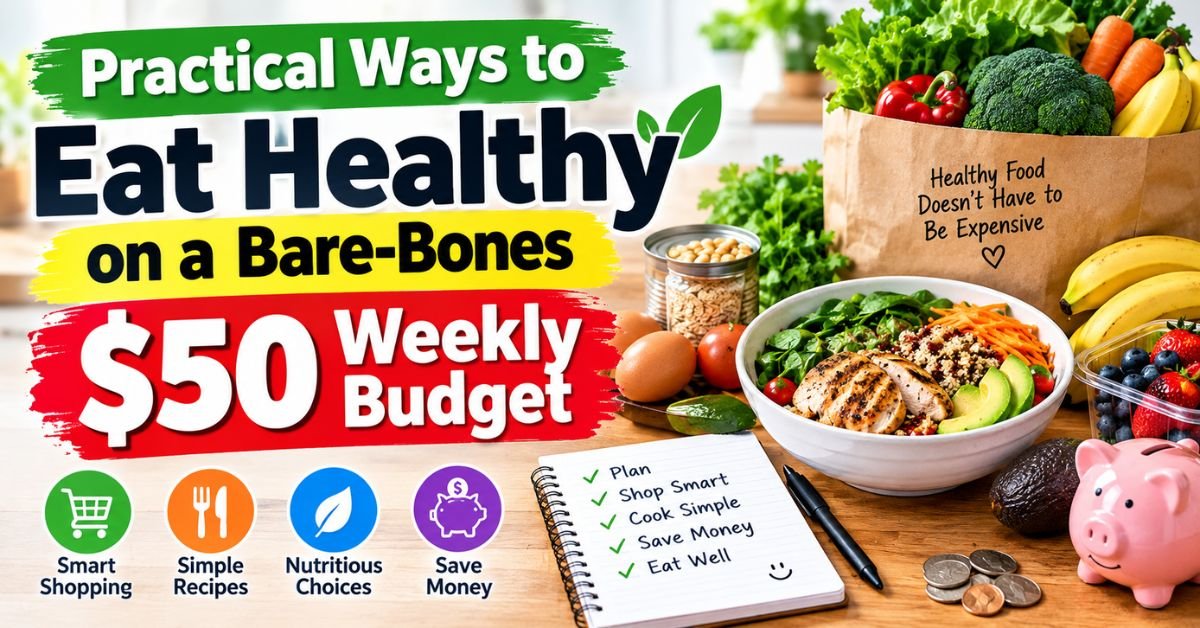
Practical Ways to Eat Healthy on a Bare-Bones $50 Weekly Budget.Standing in the center aisle of my local supermarket last October, holding an $8 box of brand-name granola and staring at the total on my phone calculator, I realized the math simply didn’t work anymore. Post-2023 grocery inflation has completely scrambled what everyday staples cost. If your bank account only allows fifty bucks for the week after rent, utilities, and gas are paid, walking into an average American grocery store can induce pure panic.
- 1. 1. The $50 Foundation: Nutrient Density Over “Diet” Marketing
- 2. 2. The Realistic $50 Master Grocery Basket
- 3. 3. Strategic Shopping Playbook: Beating Store Psychology
- 4. Rely on Unit Pricing
- 5. Avoid the Center Eye-Level Zone
- 6. Leverage Timing for Clearances
- 7. Digital Tools That Pay Dividends
- 8. 4. Batch Cooking: The “Cook Once, Repurpose Twice” System
- 9. The Sunday Workflow (Takes under 90 minutes)
- 10. Translating Components into Fast Meals
- 11. 5. Common Pitfalls That Blow the $50 Budget
- 12. The “Baggie Salad” Trap
- 13. The Convenience-Pack Tax
- 14. Buying Bulk Without a Plan
- 15. 6. Dietary Swaps: What to Do When Prices Spike
- 16. Frequently Asked Questions
- 17. Can you hit 100 grams of protein daily on a $50 weekly budget?
- 18. What if I live in an urban food desert without an Aldi or WinCo?
- 19. Are frozen vegetables as healthy as fresh produce on a budget?
- 20. How does SNAP/EBT integrate with the Double Up Food Bucks program?
- 21. What seasonings should I prioritize if my spice cabinet is bare?
Conventional financial advice usually tells you to buy bulk quinoa, organic chicken breasts, and raw almonds. If you have only a crisp fifty-dollar bill in your wallet, that advice is completely detached from reality.
The current USDA Thrifty Food Plan estimates that a single adult needs roughly $65 to $75 per week for a nutritionally minimal diet. Slicing that down to $50 requires strategy. It is entirely possible to pull off extreme budget healthy eating without surviving on sodium-heavy instant ramen or feeling lethargic by Wednesday afternoon.
Here is the exact playbook, backed by real receipt breakdowns, macro checks, and kitchen testing, for how to eat clean on a low income without losing your mind.

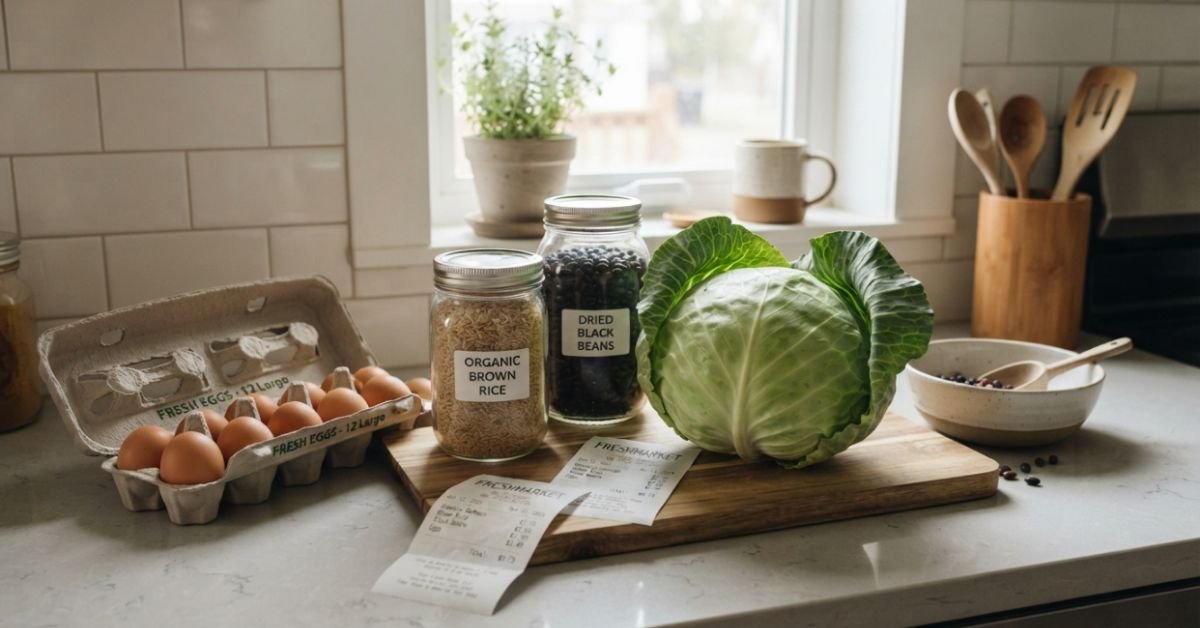
1. The $50 Foundation: Nutrient Density Over “Diet” Marketing
When you are working with groceries for one person at $50 a week, every single penny needs to purchase two things: micronutrients and satiety. Satiety comes down to the core macronutrient balance:
- Inexpensive complete proteins (eggs, canned fish, tofu, combined grains and legumes)
- Fiber-rich complex carbohydrates (brown rice and oats, whole legumes)
- Healthy fats (store-brand peanut butter, eggs, sunflower oil)
Many people think junk food is cheaper than whole food. Calorically, ultra-processed food is cheap, but it lacks dietary fiber and micronutrients. If you spend $4 on a bag of potato chips, you ingest 1,200 calories that digest in ninety minutes, leaving you ravenous and reaching for another snack. If you spend that same $4 on two pounds of dried black beans, you get roughly 3,000 calories, 180 grams of plant-based protein, and an immense wall of dietary fiber that sustains gut motility and stabilizes blood sugar for days.


+-------------------------------------------------------------+
|               THE LOW-COST SATIETY PYRAMID                  |
|                                                             |
|                    [ Healthy Fats ]                         |
|               Peanut Butter, Egg Yolks                      |
|             ------------------------------                  |
|               [ High-Fiber Complex Carbs ]                  |
|                 Rolled Oats, Brown Rice                     |
|           --------------------------------------            |
|             [ Bulky Legumes & Complete Proteins ]           |
|            Dried Beans, Lentils, Eggs, Canned Tuna          |
+-------------------------------------------------------------+
You do not need to shop at boutique health food stores to get clean nutrition. Your body does not know whether an egg came from an artisanal farm in Vermont or an economy 12-pack at an Aldi in Ohio. We want nutrient density without boutique retail markups.
💰 More Cheap Living Tips You'll Love
- How a Mid-Year Financial Reset Can Completely Transform Your Savings (Step-by-Step Guide)
- Costly Car Ownership Mistakes That Secretly Drain Your Budget Every Month
- How to Stop Impulse Buying Forever with the Seven-Day Rule
- Smart Bank Account Structuring Strategies to Automate Wealth Building
- How to Negotiate Your Internet Bill Down Without Threatening to Cancel
- The Real Cost of Daily Convenience Habits That Steal Thousands Every Year
2. The Realistic $50 Master Grocery Basket
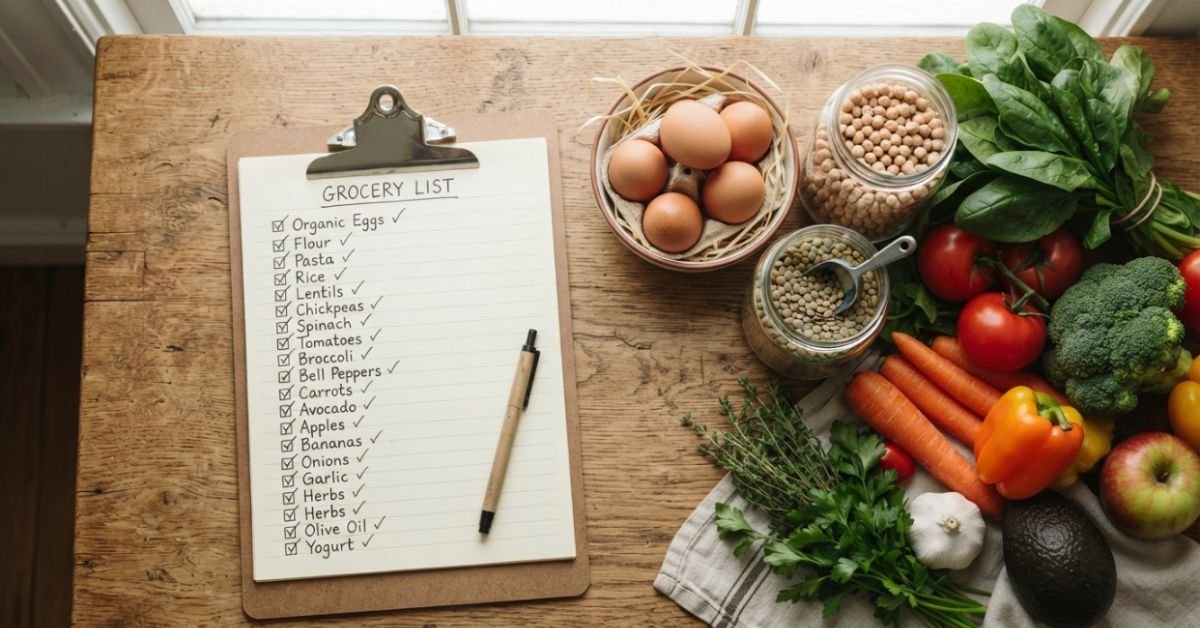
Here is a verified 50 dollar weekly grocery list healthy enough to satisfy an active adult. I priced this basket at a standard US discount grocer (Aldi and Walmart neighborhood markets) to reflect real shelf costs:


This basket provides around 2,000 to 2,200 calories per day, over 80 grams of daily protein, and more than 40 grams of daily fiber. That hits and often exceeds general adult Dietary Reference Intakes (DRI).
3. Strategic Shopping Playbook: Beating Store Psychology
Stepping into a grocery store with fifty bucks requires strict discipline. Supermarkets spend millions testing floor plans engineered to trigger impulse buying.
Rely on Unit Pricing
Never look at the large shelf tag showing the retail price; your eyes must dart straight to the tiny print in the corner showing unit pricing (cents per ounce or cents per pound). A 16-ounce bag of specialty oats might cost $2.99 ($0.18/oz), whereas the plain 42-ounce store tub costs $3.95 ($0.09/oz). The larger tub delivers twice the food per penny spent.
Avoid the Center Eye-Level Zone
Name brands pay hefty slotting fees to sit precisely at eye level (between 4 and 5.5 feet off the ground). Drop your gaze to the bottom shelf. That is where store brands, bulk dried pulses, and unbranded staples live without the marketing tax.
Leverage Timing for Clearances
Major grocery stores discount expiring animal proteins early in the morning.
- Walmart: Watch for yellow sticker markdowns in the meat department between 7:00 AM and 8:30 AM. You can routinely find split bone-in chicken breasts or ground turkey marked down by 30% to 50%.
- Kroger/Ralphs/Fred Meyer: Keep an eye out for their distinctive yellow “Manager’s Special” tags on whole poultry and store-brand dairy.
Digital Tools That Pay Dividends
- Flipp: Use it to scan circulars for Lidl, Aldi, and local salvage grocers without flipping through paper mailers.
- Double Up Food Bucks: If you qualify for or receive SNAP/EBT benefits, look for participating farmers markets across the US. Many programs match your SNAP dollars dollar-for-dollar (up to $20 per day) on locally grown fresh produce. That single mechanism can turn your $50 budget into $70 of purchasing power.
4. Batch Cooking: The “Cook Once, Repurpose Twice” System
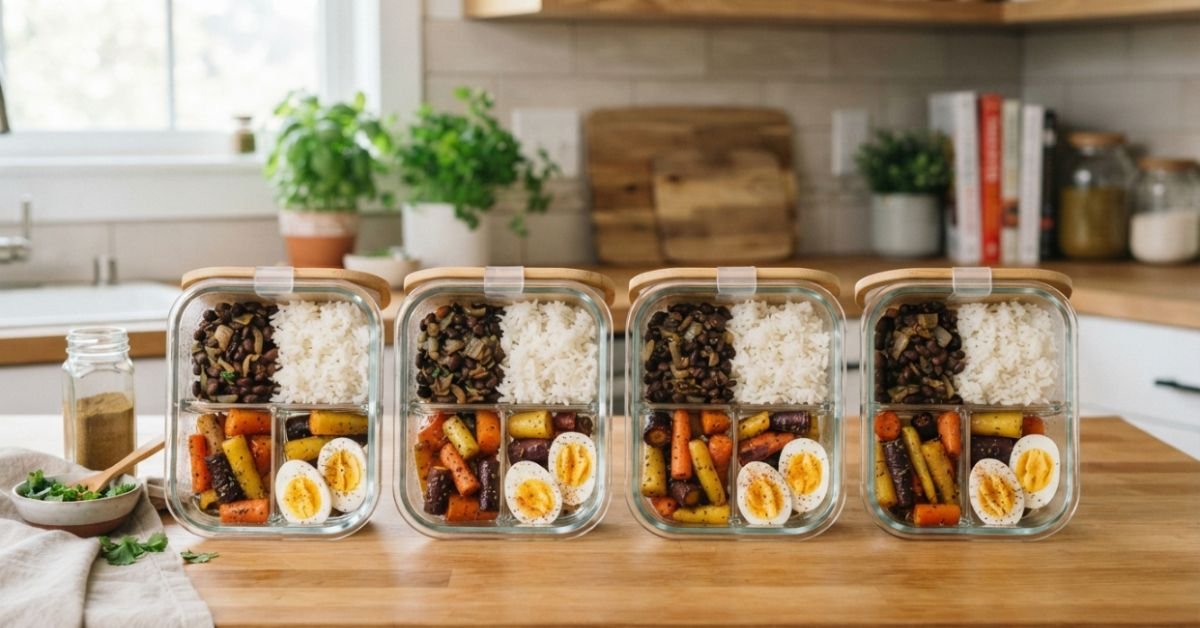
Cooking individual healthy meals three times a day on a hyper-budget burns people out fast. You run out of energy, abandon the plan, and order takeout. You avoid that by turning to meal prepping using a modular framework.
                  SUNDAY PREP: THE CORE BUILDING BLOCKS
                                    │
       ┌────────────────────────────┼────────────────────────────┐
       ▼                            ▼                            ▼
[ 1 Pot Black Beans ]      [ 1 Pot Brown Rice ]     [ 1 Sheet Roasted Carrots ]
       │                            │                            │
       └────────────────────────────┼────────────────────────────┘
                                    │
                                    ▼
       ┌────────────────────────────┼────────────────────────────┐
       ▼                            ▼                            ▼
  MONDAY / TUESDAY          WEDNESDAY / THURSDAY               FRIDAY
Spicy Rice & Bean Bowls     Savory Cabbage-Egg Slaw      Crispy Pan-Fried Tofu
w/ Sautéed Greens           w/ Flaked Canned Tuna        w/ Rice & Sardine Mash
The Sunday Workflow (Takes under 90 minutes)
- Simmer the Black Beans: Soak your dry black beans overnight to drop the cooking time down to 45 minutes. Simmer them with half an onion, two smashed garlic cloves (if on hand), salt, and water. Never toss the cooking liquid; that starch-rich broth forms the base of a quick bean stew later in the week.
- Boil the Brown Rice: Cook 4 cups of dry brown rice with 8 cups of water. This single step delivers roughly 12 cups of cooked complex carbohydrates.
- Shred the Cabbage: Thinly slice the entire head of cabbage. Do not dress it yet. Raw cabbage holds its crisp snap in a sealed container for up to 10 days, unlike boxed spring greens that decay into foul liquid by Wednesday.
Translating Components into Fast Meals
- Breakfast: Half a cup of rolled oats boiled in water, topped with a tablespoon of peanut butter, a sliced banana, and a sprinkle of salt. It yields sustained morning energy for less than $0.55 per serving.
- Lunch (Power Bowl): One cup of cooked brown rice, one cup of seasoned black beans, a cup of thawed frozen spinach quickly seared in sunflower oil, and two scrambled eggs over top. Total cost: ~$1.35.
- Dinner (Warm Fish & Cabbage Stir-Fry): Sauté shredded cabbage and thinly sliced carrots in oil until tender-crisp. Toss in a can of drained tuna or mashed sardines along with a cup of warm rice and a splash of soy sauce or salt. The cabbage provides volume that physically fills your stomach, while the omega-3 fats keep you satisfied through the night.
5. Common Pitfalls That Blow the $50 Budget
When every dollar represents 2% of your entire weekly food runway, a single wrong move can leave your pantry bare before Sunday arrives.
The “Baggie Salad” Trap
Never buy pre-washed baby spinach tubs or bagged spring mixes. They run upwards of $3.50 for a five-ounce plastic clam. Worse, their high moisture content means they rot within 72 hours. Buy whole heads of green cabbage, bags of whole carrots, or 12-ounce bags of frozen vegetables instead. Frozen cut spinach provides dense nutrition at a fraction of the price, and it cannot turn to slime in your crisper drawer.
The Convenience-Pack Tax
A bag of pre-chopped onions and celery (mirepoix) costs upwards of $3.00 for 10 ounces. You can buy three pounds of whole yellow onions and two pounds of carrots for less than that. Chopping them yourself takes all of four minutes. Don’t pay food processors $20 an hour to run a blade through an onion for you.
Buying Bulk Without a Plan
A 25-pound sack of flour or white rice looks attractive when checking the price per ounce. If you only have $50 to spend for the next seven days, spending $18 on a single giant bag leaves you with $32 for protein, produce, and fats. You end up calorie-rich and micronutrient-starved. Stick to smaller 2-to-3-pound bags until you build up a dedicated buffer fund.
Expert Insight: If a head of cabbage begins to look slightly tired or limp toward the end of your week, do not throw it away. Submerge the sliced leaves in a bowl of ice-cold water with a pinch of salt for ten minutes. The cellular walls will pull in that moisture through osmosis, snapping the vegetable right back to its original crunchy state.
6. Dietary Swaps: What to Do When Prices Spike
Avian influenza outbreaks, local supply disruptions, and regional distribution bottlenecks can send specific prices skyrocketing overnight. You need agile alternatives.
+---------------------+-----------------------+------------------------+
| IF THIS SURGES:     | SWAP WITH THIS:       | WHY IT WORKS:          |
+---------------------+-----------------------+------------------------+
| Eggs ($3.50+/doz)   | Firm Tofu Block       | Matches protein/dollar;|
|                     |                       | easy to scramble       |
+---------------------+-----------------------+------------------------+
| Canned Tuna         | Canned Mackerel /     | Often 30% cheaper;     |
|                     | Sardines              | higher healthy fats    |
+---------------------+-----------------------+------------------------+
| Rolled Oats         | Yellow Cornmeal       | Excellent carb base;   |
|                     | (Polenta)             | under $2 for large bag |
+---------------------+-----------------------+------------------------+
| Chicken Thighs      | Bulk Brown/Green      | Dense plant protein;   |
|                     | Lentils               | cooks without soaking  |
+---------------------+-----------------------+------------------------+
+---------------------+-----------------------+------------------------+
Lentils and pulses are incredible unsung heroes. Unlike dried kidney or black beans, dry brown lentils require zero pre-soaking and tenderize in twenty minutes. If egg prices go wild in your area, pick up a block of store-brand firm tofu. Drained, crumbled into a hot pan with a pinch of turmeric, salt, and pepper, it delivers an identical texture to scrambled eggs with clean plant-based protein for under $1.75.
Eating well on a lean budget is not about deprivation; it is about building baseline culinary skills, paying attention to unit costs, and ignoring supermarket marketing. Treat your kitchen like a mini workshop, cook with humble ingredients, and you will thrive on fifty dollars a week.
Frequently Asked Questions
Can you hit 100 grams of protein daily on a $50 weekly budget?
Yes. Relying on lean beef or whey isolate makes it difficult, but lean budget staples handle it easily. Combining four large eggs (24g), one cup of cooked black beans (15g), one can of chunk light tuna (30g), three tablespoons of peanut butter (12g), and two cups of cooked brown rice along with your vegetables comfortably crosses 90 to 105 grams of protein per day.
What if I live in an urban food desert without an Aldi or WinCo?
If you are limited to inner-city corner bodegas or dollar stores (like Dollar General or Family Dollar), look for dry goods. Most Dollar General stores stock plain rolled oats, white or brown rice, dry pinto beans, canned tuna, and peanut butter. Avoid their processed snack aisles and single-serve frozen meals, which carry massive markups per ounce.
Are frozen vegetables as healthy as fresh produce on a budget?
Yes, and in some cases, they are more nutrient-dense. Produce meant for the freezer aisle is typically flash-frozen immediately after harvest, locking in peak vitamins and minerals. Fresh produce often spends days in refrigerated transit and on retail shelves, slowly losing light- and heat-sensitive nutrients like Vitamin C and folate.
How does SNAP/EBT integrate with the Double Up Food Bucks program?
Double Up Food Bucks operates in over 30 US states. When you spend SNAP/EBT funds on fresh fruits and vegetables at participating farmers markets and select community grocers, the program matches what you spend (frequently up to $20 a day) with tokens or vouchers usable on additional fresh local produce. You can look up your state’s active market network at doubleupfoodbucks.org.
What seasonings should I prioritize if my spice cabinet is bare?
Do not spend your weekly food allocation on expensive spice bottles. Start with three foundational, inexpensive staples: fine iodized table salt, whole black peppercorns (or ground black pepper), and a large economy shaker of garlic powder. When your budget has a small surplus, pick up ground cumin and crushed red pepper flakes. These few items give you plenty of room to shift flavors between Mexican, Mediterranean, and East Asian profiles without spending much.